Biden, Warren, and Sanders are Beardstown Ladies?

Today was supposed to be the last Democratic Presidential primary. We’ve heard primarily from three candidates: Joe Biden, Bernie Sanders, and Elizabeth Warren (though this article says that all of them are essentially just repeating things that Bernie Sanders said in 2016).

All of these Democrats have said that, through the magic of higher tax rates on the rich, the Federal government will be showered in tax revenue, breaking out of Hauser’s Law that found revenue to be limited to about 20 percent of GDP, independent of the headline rates (1945-2015). In the page pandering to Catholic voters, for example, Biden promises to “get rid of the capital gains loophole for multi-millionaires.” So a multi-millionaire would have to pay a 50% ordinary income tax rate, federal plus state, on capital gains but wouldn’t be able to move to Puerto Rico for 183 days/year and pay 4% instead under Act 22 (and that would be to Puerto Rico, so the Federal Government would get 0%).

I wonder if this kind of magical thinking about the possibilities of a high return on an investment of tax rates is partly due to the politicians’ age. They’re all senior citizens and senior citizens can be prone to mistaken estimates. One of the most famous examples of this is an investment group of women in their 70s known as the Beardstown Ladies, They believed that they’d achieved a 23 percent annual return on investment, beating the S&P 500. When younger people analyzed their returns, the conclusion was that the return had been 9 percent annually, underperforming the S&P 500.

[Some more fun stuff… All of the Democrats told us that immigration will make existing residents of the U.S. better off. It doesn’t matter how low the skill level of the immigrant nor how much in the way of government-provided services the immigrant needs. A 75-year-old migrant who does not speak English and who needs $2 million in health care will make every existing American slightly richer. Admitting several million elderly disabled non-English-speaking immigrants would make us crazy rich.

Joe Biden will deny that there is anything special about having been born with a physician-identified biological female sex at birth (“LGBTQ+ Equality”; what about LGBTQIA+?), but the rest of his policy pages refer to “women” as though it were a persistent well-defined category of humans.]

Readers: What do you think? Are the leading Democrats examples of the elderly being bad at arithmetic? Should we all make sure that we have a durable power of attorney set up for the day that we turn 70 and can’t trust ourselves to make a stock trade?

Full post, including comments

Father’s Day reflections: How not to get a job at Hallmark

Some epic tweets regarding yesterday’s Hallmark Holiday of Father’s Day:

The author is “Feminist, socialist, part of the 99% and proud.” Can we agree that she would have a tough time getting a job at Hallmark, makers of cards for the 100%?

Separately, circulating in some (apparently deplorable) aviation groups: “Your dad’s not a pilot? Well, Happy Mother’s Day to your dad.”

Full post, including comments

How can ordinary people buy the statues that are being pulled down?

“Roosevelt Statue to Be Removed From Museum of Natural History” (NYT): “The equestrian memorial to Theodore Roosevelt has long prompted objections as a symbol of colonialism and racism.”

I celebrate this decision because I would love to see this statue replaced with one of Donald Trump on a golf cart (and also to see Donald Trump’s image carved into Mt. Rushmore, either to join Teddy Roosevelt or to replace him; photo I took from a friend’s Mooney in 2002 shows that there is plenty of room; the lower photo shows that there is already a venue there architecturally suitable for a fascist rally).

As a practical matter, though, where can people buy these discarded works of art? Our neighbors, for example, all have enough room for such a statue, thanks to our two-acre zoning minimum (ensures that none of the low-income black Americans whose lives matter to us (judging by the hundreds of Black Lives Matter signs in our town) can afford to move in). But will they be on eBay or what?

(What did TR actually say about Black Lives Matter? “Teddy Roosevelt discusses America’s race problem” describes a 1905 speech:

In his argument for racial equality, Roosevelt used the rising tide raises all ships metaphor, stating that if morality and thrift among the colored men can be raised then those same virtues among whites, already assumed to be more advanced, would rise to an even higher degree. At the same time, he warned that the debasement of the blacks will in the end carry with it [the] debasement of the whites.

Roosevelt’s solution to the race problem in 1905 was to proceed slowly toward social and economic equality. He cautioned against imposing radical changes in government policy and instead suggested a gradual adjustment in the attitudes of whites toward ethnic minorities. He referred to white Americans as the forward race, whose responsibility it was to raise the status of minorities through training the backward race[s] in industrial efficiency, political capacity and domestic morality. Thus, he claimed whites bore the burden of preserving the high civilization wrought out by its forefathers.

I wonder what he would say if he could see the “forward race” of white Americans consuming millions of taxpayer-funded opioid pills!)

Related:

Full post, including comments

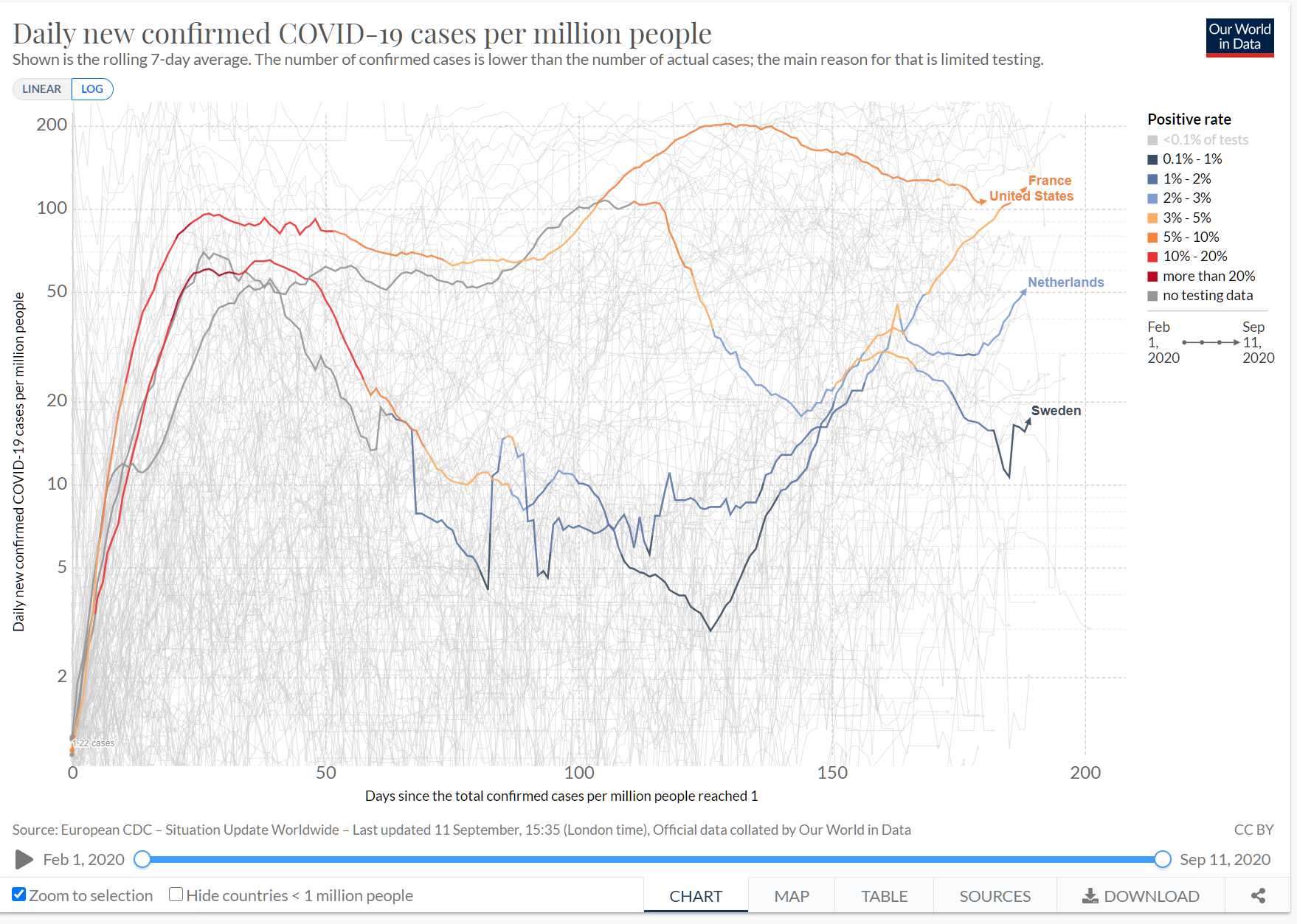
How is Sweden doing with coronaplague?

I like to check in on forecasts versus reality at three-week intervals. Maybe prophets are getting better!

Previous posts:

From the first of those…

What’s the latest from the prophets at IHME? As of a May 20 update to the forecast, Sweden will have a gradually declining daily number of deaths, in more or less the same shape as still-shut-down Massachusetts. A total of 5,129 Swedes will die from/with Covid-19 (roughly one third the previous forecast). The virus will simply burn itself out, apparently, despite Sweden’s lack of shutdown. (But in other countries, the same shape decline will be attributed to a multi-month shutdown?)

That forecast for Swedish death was down from the 13,529 number in the early April forecast. As of June 5, 2020, the IHME model forecast 8,534 deaths for Sweden and the deaths will come in a Bactrian camel shape:

The forecast from June 5 predicts 60-70 deaths per day right around now. What are we seeing? Europeans refuse to work on weekends, so the reported deaths are zero for Saturday and Sunday. Even today’s report shows 0 deaths (so maybe tomorrow’s report will actually reflect three days of deaths?). The Friday report shows 12 new deaths reported in Sweden.

[Update: The Tuesday report included 69 new deaths. So that’s 81 new deaths spread over 5 days of reports (12+0+0+0+69) or 16 deaths per day compared to the forecast 60-70. In other words, the forecast was wrong by 4X.]

(Also from the Tuesday reports: Sweden has suffered 5,122 deaths from its population of 10 million. Massachusetts has lost 7,890 from its population of 7 million. In Month 4 of Shutdown, the Massachusetts rate is 2.2X Sweden’s.)

What about the former chief scientist of the European CDC who, when put on the spot, tossed out that coronaplague wouldn’t be worse than a bad flu season in terms of death? (note that assumptions regarding population fatality rate were not important for the Swedish plan; assumptions regarding the practicality of a non-Chinese country significantly changing the trajectory of infections were)

A bad season indeed was 1957-8, in which up to 116,000 Americans died out of a population of 172 million (compare to 330 million today). Applying that rate to Sweden’s 10 million people, 6,744 Swedes would succumb to Covid-19.

I don’t think economic arguments are highly relevant in a world where people seemingly care only about clinging to life. Nonetheless, since poverty often determines health outcomes: https://www.bloomberg.com/amp/news/articles/2020-06-16/one-economy-stands-out-as-crisis-reveals-striking-differences? (see “Most gunshot wounds are self-inflicted, coronaconomy edition”)

Readers: What’s your best guess on Sweden? How will the death rate from/with Covid-19 compare to the U.S. rate by early 2021? (right now the U.S. has roughly 71 percent of the death rate compared to Sweden, so the U.S. is better if we measure only by this one number)

[Update 6/24: the IHME prophets have released a new projection.

Instead of the Bactrian camel, Sweden is now on the dromedary shape. There is a new “what if?” capability in this model. For example, if only 10 million Swedes would put on masks, 2 lives would be saved on September 1. (but how many would be killed in car-pedestrian accidents due to fogged-up eyeglasses from the masks?). 5,754 Swedes will meet their end due to Covid-19 through October 1, 2020, a population fatality rate of nearly 0.06 percent.]

Related:

Full post, including comments

Most U.S. states are now on the Swedish plan?

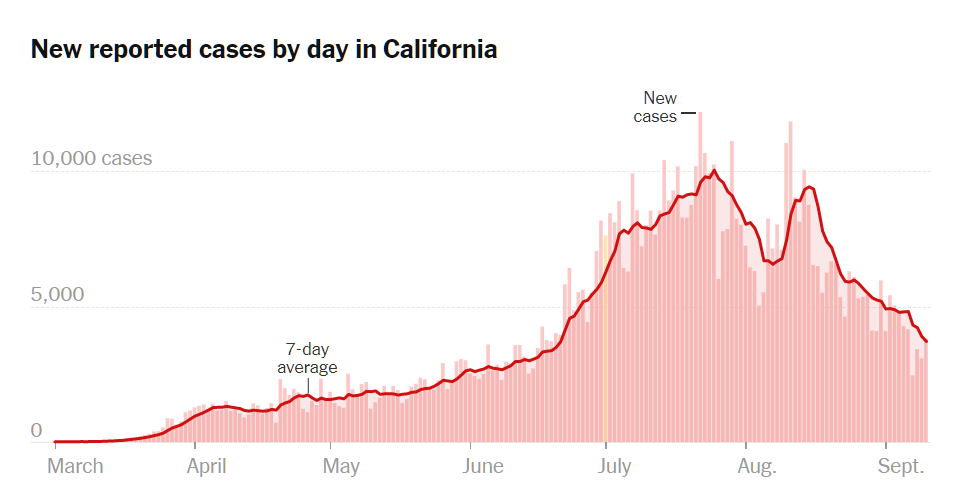
My Facebook feed is alive with righteous expressions of outrage at growing coronaplague in reopened Sun Belt states. A typical story posted, underneath some complaints about the unmasked, Donald Trump, etc., would be “Florida shows signs as next coronavirus epicenter as cases spike across the country” (CNN, June 18) or “Coronavirus Cases Spike Across Sun Belt as Economy Lurches into Motion” (NYT, June 14).

I wonder if the majority of U.S. states inadvertently adopted the Swedish approach to managing COVID-19.

Consider that the shutdown happened in a lot of states at a time when there was, in fact, hardly any virus at all. The shutdowns were therefore months too early to have any effect, even if one were to accept that shutdown accomplishes anything, because the virus does not spread in the U.S. suburbs the way that it spread in Wuhan, New York City, or Italy.

So essentially the shutdown never happened from the perspective of the virus. The typical U.S. state now has the general population running around and mingling more or less as in 2019, while retirement homes and nursing homes are “locked down” as best they can be (temperature checks, etc. for the staff; restrictions on visitors). The immunocompromised, otherwise vulnerable, and healthy-but-fearful are hiding in individual bunkers (apartments/homes). Mass gatherings are canceled. How is that different from the Swedish policy?

Stockholm, 2016:

Related:

Full post, including comments

From which file sharing service will people pull videos out of the memory hole?

“BBC remove Fawlty Towers’ iconic ‘Don’t Mention The War’ episode from UKTV streaming site” (The Sun):

The streaming service which is owned by the Corporation, have decided to take down the episode that also features racial terms.

This is the latest “classic” British TV show to be removed from a streaming service owned by the BBC, as broadcasters continue to re-assess old British television content.

This Fawlty Towers episode in question was first broadcast in 1975, also features Cleese’s bigoted character who was in hospital and was shocked when he was treated by a black doctor.

Where will people find the content that their morally superior overlords have decided needs to be stuffed into a memory hole? Is BitTorrent sustainable or can it be shut down easily by governments and ISPs under the rubric of protecting copyright (i.e., the right of the owner to block anyone from ever seeing something again)?

People are pirating copies of movies already, right? How are they doing it? Will the mechanisms of today still work in 20 or 30 years?

John Cleese in 2019, from the Daily Mail:

'Finally got it right': John Cleese revealed he 'finally got it right' with his fourth wife after a string of failed marriages - and admitted he still only feels 43 despite his 80th birthday fast approaching

Related:

  • “Gone with the Wind removed from HBO Max” (BBC)
  • “John Cleese’s Alimony Payments Are No Laughing Matter” (HuffPost): In a new interview with the Sunday Morning Herald, the 74-year-old funnyman opens up about his 2008 divorce, touring, and the perception that he’s financially set thanks to his success with “Monty Python.” … “I will have paid my ex-wife, I think it is $23 or $24 million. That’s an awful lot of money. And when you have to pay it over a period of seven years, even if you sell a lot of properties — like I had five and I now have one — there’s still a lot of simple, hard work to be done just to earn the rest of it.” … The former couple has no children. [see Real World Divorce on England]
  • “Berkeley Will Delete Online Content” (20,000 lectures withdrawn from the public due to “receiving complaints from two employees of Gallaudet University, saying Berkeley’s free online educational content was inaccessible to blind and deaf people because of a lack of captions, screen reader compatibility and other issues.”)

Full post, including comments

Facebook helps manufacture consent around the idea of white privilege

Want to write on Facebook about “white privilege” and how “It’s for sure a white man’s world in America. … All you got to be is white in America to get whatever you want”? (see Being There) Go for it!

What about disagreeing with this, however obliquely? A Facebook friend wrote the following:

There are tens of millions of racists in america but most are white trash who don’t make any decisions that matter.

His account was suspended.

A friend’s post, quoting “Jeff Jarvis: ‘As an old, white American man, I must confess it’s people like me who got us here'”:

Soon, by 2050, the white majority in America faces the reality that it will become the white minority and that scares them. The most frightened are the uneducated, old, white men who hold privilege and power and realise how tenuous that hold is because it is based on what they had in the past — who they are — rather than what they contribute to the future — what they can do.

I responded with the following:

If they’re uneducated and old, how are they privileged? If they’re over 40, they wouldn’t even be able to get a job absent government coercion (see https://www.eeoc.gov/age-discrimination ).

My friend:

Because things would be even harder for them if they were uneducated, old, and not white. I think Jeff does a good job of defining privilege: when you get things others don’t because of who you are, rather than because of what you can do.

Me:

Let that uneducated unemployed old white guy go out on Tinder and see how far his privilege takes him….

(if he is successful on Tinder and his partner chooses not to abort the resulting child, see Real World Divorce to calculate the cash flow in various states)

His friends piled on about how wrong I was. Me:

Only a few years ago, these same men were being featured as victims by our media. Now they are “privileged” and “powerful”? From 2016, CNN: “Nearly one-quarter of white men with only a high school diploma aren’t working.”

As of 2017, they were dying even if the police didn’t have enough energy to kill them. ‘The Collapse of the White Working Class’ (Atlantic)

Readers: Why is the idea that all whites, however poor, uneducated, and old, are privileged suddenly so important that Facebook needs to censor dissenting points of view?

(Another Facebook friend was blocked for 30 days due to his attempt to make a point via sarcasm:

White men are the only rapists in the world. How can I disagree with the consensus view of the Ivy League elites?

See also “The Question of Race in Campus Sexual-Assault Cases” (Atlantic). Regarding the Obama-mandated on-campus sexual assault tribunals: “Black men make up only about 6 percent of college undergraduates. They are vastly overrepresented in the cases I’ve tracked.”)

Related:

Full post, including comments

Immigrants on Juneteenth

In a country where some people showed up only recently (see “Modern Immigration Wave Brings 59 Million to U.S., Driving Population Growth and Change Through 2065”), how many people are interested in a conflict that may have occurred years or centuries before they or their ancestors arrived in the U.S.?

I surveyed some immigrants and children of immigrants regarding Juneteeth.

A Russian-Ukrainian: I was just discussing it with another immigrant. We had no idea this day existed. We had no idea this day existed. Russia abolished serfdom around the same time. No one keeps track who descended from the serfs.

A Hungarian: We got the day off and my company sent around some interesting background material. [I couldn’t get him to explain what he found interesting about it, given that he arrived in the U.S. only a few years ago. decades after the Eisenhower-era desegregation initiatives, for example.]

Child of immigrants from India: The whole thing is stupid.

Immigrant from China: This has nothing to do with me.

Immigrant from Russia: What would happen to me if I said that I was also likely a descendant of slaves?

Immigrant from Russia, asked “What did you do for Juneteeth?”: I have a job.

Immigrant from Korea: At this rate, Americans will need more than 365 days in the calendar. Why do the gays get a whole month if the slaves get only one day?

Immigrant from Ukraine: I heard some noise from their parade a block away. Apparently black parades are allowed during covid. My company gave us a floating day for reflection this year.

Child of immigrants from India: When do regular Americans work?

Readers: What do your immigrant friends say about inheriting this old conflict?

From a February stop in Charleston, South Carolina, a plaque regarding a 1951 desegregation case.

Full post, including comments

Professor Karen prefers to stay home this fall

“Expecting Students to Play It Safe if Colleges Reopen Is a Fantasy” (nytimes), is by a 67-year-old professor whose paychecks are guaranteed to keep rolling in. What does Professor Karen (a.k.a. “Laurence Steinberg”) say?

Safety plans border on delusional and could lead to outbreaks of Covid-19 among students, faculty and staff.

Most types of risky behavior — reckless driving, criminal activity, fighting, unsafe sex and binge drinking, to name just a few — peak during the late teens and early 20s.

First, this is the age at which we are most sensitive and responsive to the potential rewards of a risky choice, relative to the potential costs. College-age people are just as good as their elders at perceiving these benefits and dangers, but compared with older people, those who are college-aged give more weight to the potential gains. They are especially drawn to short-term rewards.

This is fascinating to me! The alter cocker calls the students reckless and implies that they are not properly weighing “dangers” when, in fact, healthy 18-22-year-olds don’t face any “danger” from coronaplague! Out of 7,647 people killed in Massachusetts by/with Covid-19 through June 15, exactly 15 were under 30:

Maybe those 15 were running around the soccer field the day before coronavirus struck them down? Not likely. 98.3 percent of Covid-19 deaths in Massachusetts are among those “with underlying conditions” (dashboard example).

The old cower-in-place advocate for Zoom continues to write with the assumption that young people are taking “risks” unreasonably.

Finally, college-age people show more activation of the brain’s reward regions and are more likely to take risks when they are with their peers than when they are alone. There are no such effects of peers among people who are past their mid-20s.

Not all adolescents are risk-takers, of course, and not all adults are risk-averse. But it’s hard to think of an age during which risky behavior is more common and harder to deter than between 18 and 24, and people in this age make up about three-fourths of full-time American undergraduates. … It’s one of those perfect storms — people who are inclined to take risks in a setting that provides ample temptation to do so.

The NYT reader will infer from this that two slender undergraduates meeting for coffee are taking roughly the same level of personal risk that Andy Green took while driving ThrustSSC at 763 mph.

My pessimistic prediction is that the college and university reopening strategies under consideration will work for a few weeks before their effectiveness fizzles out. By then, many students will have become cavalier about wearing masks and sanitizing their hands. They will ignore social distancing guidelines when they want to hug old friends they run into on the way to class. They will venture out of their “families” and begin partying in their hallways with classmates from other clusters, and soon after, with those who live on other floors, in other dorms, or off campus. They will get drunk and hang out and hook up with people they don’t know well. And infections on campus — not only among students, but among the adults who come into contact with them — will begin to increase.

I look forward to a time when we are able to return to campus and in-person teaching. But a thorough discussion of whether, when and how we reopen our colleges and universities must be informed by what developmental science has taught us about how adolescents and young adults think. As someone who is well-versed in this literature, I will ask to teach remotely for the time being.

In other words, “Science (TM) tells me to stay at home and watch the direct deposits stack up in my bank account while occasionally checking in via Zoom.”

In what other universe would a national newspaper run a plea by an old guy who wants to sit at home and do almost nothing, but still get paid at 100 percent?

Related:

Full post, including comments

What I learned about teaching computer nerdism remotely

My favorite kind of computer nerdism class is the lab class. Software development is a skill and the only way to learn it is by doing. A lecture from a successful programmer will not turn beginners into successful programmers.

In mid-March we got kicked out off campus. We had been teaching successfully (at least from our self-serving point of view!) in a classroom at Harvard Medical School. Three groups of three students each in the same room. By walking around we could fairly quickly see what was on everyone’s screen, help as necessary, and talk either to the entire group of 9 or to one group of 3. Groups of 3 could talk amongst themselves without disturbing the others.

Using Webex and Zoom reduced productivity by at least 70 percent. We could work with only one student’s screen at a time and essentially only one team at a time. Switching from screen to screen is a cumbersome time-consuming heavyweight process.

Now that we’re going to stay home for the next 20-50 years (even if we cure coronavirus, we still have influenza as our mortal enemy, right?), what would the ideal infrastructure be for teaching our brand of computer nerdism?

In addition to a personal monitor or two, the teacher needs an array of 9 monitors, each one at least as large physically as a student’s screen (teachers have older eyes than do students, typically!). This will enable the teacher to see what each student is doing and interrupt with help as necessary. We need four voice chat channels: one for each student group and one for the entire class. Each student needs two physical screens. One for himself/herself/zerself/theirself to use for editing and running SQL and R code and one as a mirror of the teacher’s screen (how else will students know which sites teachers like to visit?).

If we had had this infrastructure, I think we could have been 80 percent as productive as we had been during our physical meetings.

Readers: What else would help for hardware and software infrastructure for teaching?

Related:

Full post, including comments