If COVID-19 vaccines weren’t tested on likely COVID-19 victims, how do we know that they will reduce COVID-19 deaths?

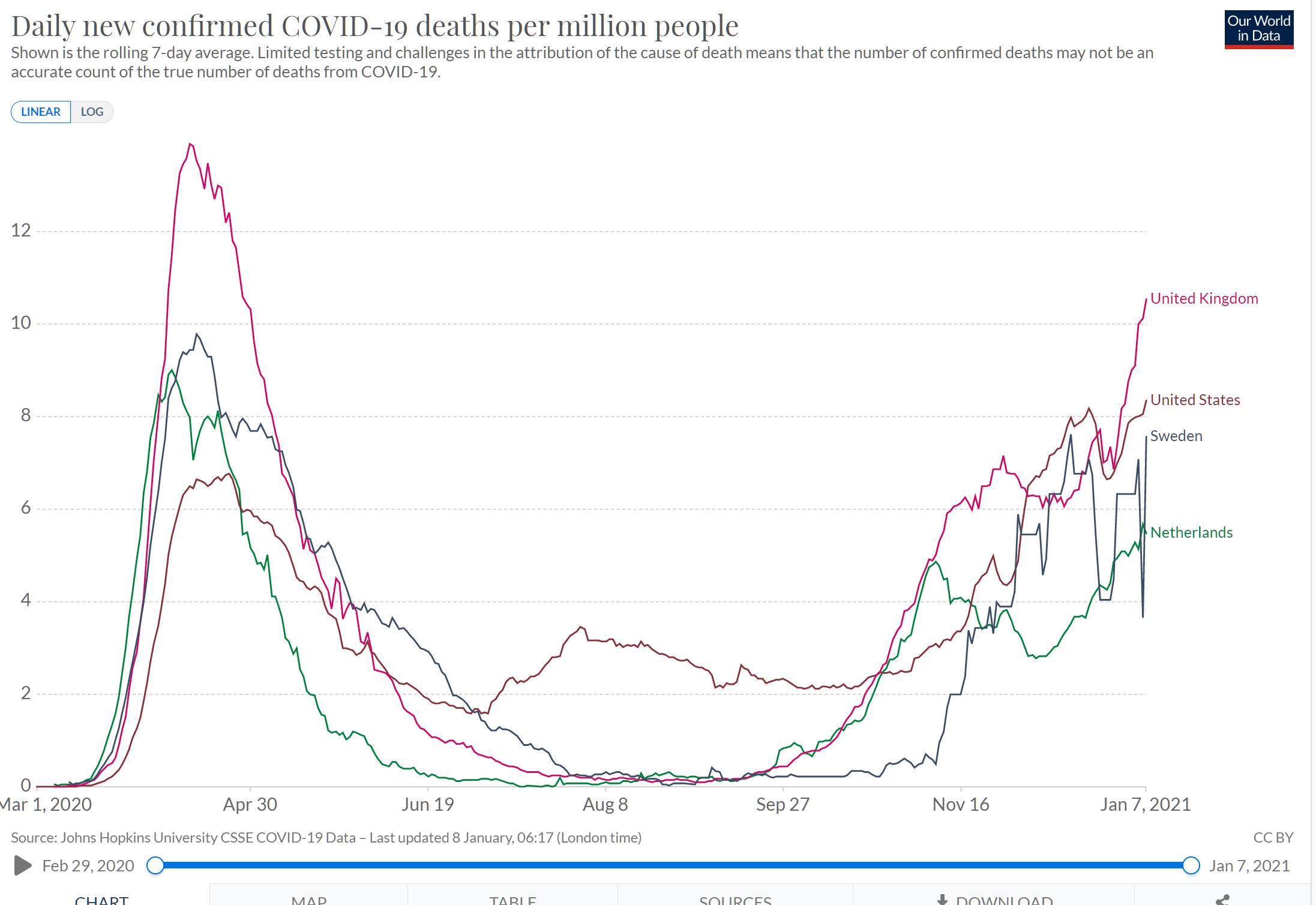
Sweden, in which coronaplague was allowed to rage while the population continued sending children to school, sending adults to work, restaurants, the gym, etc., will have about the same death rate in 2020 as compared to 2010 (stats; be sure to adjust for population growth of 9.5 percent from 9.34 million in 2010 to 10.23 million today). This suggests that most of the people whose deaths were tagged to COVID-19 were, as the Swedish MD/PhDs said, on track to die from some other cause at some point in 2020. In other words, COVID-19 kills humans who are already 98-99 percent dead (watch out, Joe Biden, even if you do have a Dr. in the house).

What we’ve heard so far from the vaccine trials are the following:

  • the vaccines don’t stop people from getting infected or spreading the infection to others
  • the vaccines cut down on symptoms and severity of an infection

So… the vaccines might actually make an epidemic worse, in terms of the percentage of the population infected, because people who are infected won’t feel sick and therefore won’t #StayHomeSaveLives.

Maybe this would be fine if we can be sure that vaccinated people won’t die with a COVID-19 toe tag. But do the clinical trials tell us that? Did they go to nursing homes and find the sickest oldest most machine-dependent humans? Given that nursing homes are completely locked down, even if they had found such trial subjects, what could be learned from folks who, by design, are shielded from all exposure?

Let’s have a look at the Moderna FDA paperwork. Only 3 people in the vaccine group, out of 15,208 total, died during the study (approximately 3 months; see pages 17 and 18), which tells you that Moderna picked a much healthier population with a much longer life expectancy than the kinds of people who have been tagged on death with COVID-19 positive test result. (If we assume that a typical COVID-19-tagged death is among those with a life expectancy of 4 years, we would have expected at least hundreds of deaths during a similar study of vaccination among people who really need the vaccination. Note that the Swedish data suggest that 4 years is an overestimate.)

Table 6 says that 4 percent of the study participants had “two or more high risk conditions” and that 25 percent were over 65 years of age, but here in Maskachusetts before the state pulled the age-related data, the median age of a “COVID-19 death” was 82 and more than 98 percent of those had an “underlying condition.”

It is nice that a healthy out-and-about 66-year-old develops a good immune response from these injections, but does that tell us that an extremely unhealthy 82-year-old with just a year or two of life expectancy will develop a similarly good immune response?

So… is it fair to say that we can hope, but not expect, these vaccines to stop the kinds of “COVID-19 deaths” that have been Americans’ consuming obsession?

(A med school professor friend: “Good question, probably not.”)

Loosely related…

Full post, including comments

Our apolitical science-driven physicians

From the New England Journal of Medicine, i.e., the folks whom we can trust to give us science-informed advice on masks and vaccines, untainted by a political point of view… “Failed Assignments — Rethinking Sex Designations on Birth Certificates” (December 17, 2020):

We believe that it is now time to update the practice of designating sex on birth certificates, given the particularly harmful effects of such designations on intersex and transgender people.

Recognizing that the birth certificate has been an evolving document, with revisions reflecting social change, public interest, and privacy requirements, we believe it is time for another update: sex designations should move below the line of demarcation.

Designating sex as male or female on birth certificates suggests that sex is simple and binary when, biologically, it is not. Sex is a function of multiple biologic processes with many resultant combinations. About 1 in 5000 people have intersex variations.

Assigning sex at birth also doesn’t capture the diversity of people’s experiences. About 6 in 1000 people identify as transgender, meaning that their gender identity doesn’t match the sex they were assigned at birth. Others are nonbinary, meaning they don’t exclusively identify as a man or a woman, or gender nonconforming, meaning their behavior or appearance doesn’t align with social expectations for their assigned sex.

Moving sex designations below the line of demarcation wouldn’t imperil programs that support women or gender minorities, it would simply require that programs define sex in ways that are tailored to their goals.

Moving sex designations below the line of demarcation may not solve many of the problems that transgender and intersex people face. Controversies regarding bathrooms, locker rooms, and sports participation will continue, regardless of legal sex designations.

Today, the medical community has a duty to ensure that policymakers don’t misinterpret the science regarding sex and that medical evaluations aren’t being misused in legal contexts.

Also, “A Test of Diversity — What USMLE Pass/Fail Scoring Means for Medicine” (June 18, 2020):

The stakes are high for all students taking this first Step examination of the three required for medical licensure. But students from racial and ethnic groups that are underrepresented in medicine experience great angst.

Recently, the Federation of State Medical Boards (FSMB) and the National Board of Medical Examiners (NBME) decided to change score reporting from a three-digit numerical score for the Step 1 exam (the mean score for first-time takers was 230 in 2018) to a pass-or-fail outcome. … Although the effect on trainees from underrepresented groups remains uncertain, we believe that the change is a critical step toward diversifying the medical profession — particularly the most competitive, and simultaneously least diverse, medical specialties — opening a world of possibilities for physicians and patients alike.

The odds are stacked against students from underrepresented minority groups starting early in their scholastic journeys. Beginning in grade school, they may be subject to teachers’ racial and ethnic biases that can hinder their achievement. Socioeconomic factors such as neighborhood poverty and parental educational attainment may limit their access to high-quality schools, test-preparation resources, and supportive mentorship, widening the achievement chasm.

The medical examination system poses challenges that are especially burdensome to students of color and those with lower socioeconomic status. Step 1, much like the Medical College Admission Test (MCAT), places a financial burden on students that includes the cost of the exam ($645 in 2020) and the study materials required to prepare for it.

As with the MCAT, scores on Step 1 are lower among black, Hispanic, Asian-American, and female students than among their white male counterparts. Although this disparity has multiple causes, historically disadvantageous early education in minority communities probably plays an important role for members of underrepresented minority groups.

… we believe that holistic review will be a tide that raises all ships equitably.

The last sentence is my favorite. There are a limited number of slots for training the most lucrative and cushiest specialties, but everyone will have a better chance of obtaining a slot after this change.

Full post, including comments

Merry Christmas from the iPhone 12 Pro Max

A challenging high-contrast night scene for the iPhone 12 Pro Max:

I hope that you all appreciate our Christmas lights…. Merry Christmas!

(Okay, perhaps I have falsely taken credit for this neighbor’s epic display.)

As long as we’re celebrating Jesus’s birthday, a story about his father/mother/other….

Rudy Giuliani and Victoria Toensing are leaving the courtroom after arguing on behalf of Donald Trump and they get hit by a taxpayer-funded empty city bus.

God meets them at the pearly gates and asks if they have any questions.

“Yes, we do,” says Giuliani. Toensing steps forward and asks “What would the result of the 2020 election have been without the Democrats’ fraud?”

God replies, “It was an unusual year, with all of the unsolicited mail-in ballots encouraging my lazy young children to vote for the first time. But the 18-year-olds actually did vote for a bigger government and for Presidents Biden and Harris. Remember that it will be years before most of them get jobs and start paying taxes, so it makes sense for them to vote for more handouts. Removing the fraudulent ballots wouldn’t have changed the result. Biden won by a narrow margin.”

Rudy Giuliani and Victoria Toensing are stunned. After a moment of silence, Giuliani turns to Toensing and whispers, “This goes higher up than we thought.”

Full post, including comments

Christmas present for deskbound healthcare heroes: a vaccine shot

Our mole in the U.S. health care system, the author of Medical School 2020, reports that his hospital ended up being supplied with way more coronavirus vaccine than needed for patient-facing clinical workers. “It doesn’t last that long, so they needed to get rid of it.” Did they take the leftovers to the local nursing homes and try to save the elderly? “No,” he responded. “They’re just giving it to anyone with a badge, even if they’re not clinical.”

Happy Christmas Eve! Here’s hoping that Santa brings you a vaccine, even if you don’t need one!

Related:

  • “Does the flu vaccine work as well in elderly people?” (health.harvard.edu): The flu vaccine can be less effective in elderly adults. That’s because the flu vaccine works by priming the body’s own immune system to mount a response to the virus if it’s encountered. Older adults may have weaker immune systems, and therefore a weaker immune response to the vaccine.
  • “Fact check: Coronavirus vaccine could come this year, Trump says. Experts say he needs a ‘miracle’ to be right.” (NBC, May 15, 2020): “I think it’s possible you could see a vaccine in people’s arms next year — by the middle or end of next year [2021]. But this is unprecedented, so it’s hard to predict,” said Dr. Paul Offit, a professor at the Perelman School of Medicine at the University of Pennsylvania and the director of the Vaccine Education Center at Children’s Hospital of Philadelphia. … “A lot of optimism is swirling around a 12- to 18-month timeframe, if everything goes perfectly. We’ve never seen everything go perfectly,” [Rick] Bright said. “I still think 12-18 months is an aggressive schedule, and I think it’s going to take longer than that to do so.” Bright, an internationally recognized vaccine expert, filed a whistleblower complaint alleging that he was fired for opposing the use of an unproven coronavirus treatment promoted publicly by the president. Trump has called Bright a “disgruntled” employee.
Full post, including comments

A friend’s COVID-19 journey

A friend here in Maskachusetts has been fairly careful to avoid COVID-19. He’s supposedly in a “bubble” with three kids, their mom, the outside nanny, and her boyfriend. He’s in a suburban fortress to which everything is delivered by an army of essential workers. Nonetheless, he began feeling unwell on December 7. On December 9, he had a PCR test, which came back negative. He and his wife both lost their senses of taste and smell, but otherwise the symptoms were milder than a typical cold. A December 14 sample tested positive. He is in his 40s and was fully recovered by December 17. The wife (30s) and kids (1-year-old twins; 3) recovered sooner. The children had mild symptoms for just a day or two (one of the 1-year-olds did test positive).

The source of the infection was traced to the nanny, a young migrant from Latin America. Perhaps her boyfriend was in a bubble with some gals from Tinder while the nanny was bubbling with the kids? Her immigration status is unclear, but “individuals detained by ICE were 13 times more likely to have COVID-19 than members of the U.S. general population in April-August 2020” (“Impact of COVID-19 on the Immigration System”).

Arranging testing here in Maskachusetts was burdensome and slow. After a couple of days to arrange a test, results took as long as four days to come back. As with roughly half of tests of folks who are infected, my friend’s first test was a false negative (probably due to his body not putting virus on the swab, not due to a mistake in the PCR process). He didn’t receive laboratory confirmation of his disease until after the end of the CDC-recommended quarantine period for the disease (i.e., Kary Mullis‘s invention wasn’t medically or epidemiologically useful).

Along with a higher rate of current COVID-19 infection than never-masked never-shut South Dakota (CDC), we also had more than a foot of snow fall on the ground prior to the official start of winter:

Where is global warming now that we need it?

Related:

Full post, including comments

Windows or MacOS better for restricting teenager activity online?

As noted in Coronapanic proved Greta Thunberg right, 2020 will go down in history as the year when adults stole the most from children (a whole year of their educational and social life in hopes that a handful of (mostly very old) adults might live a few additional years).

American children are now supposed to be focused computer users all day at home in “remote school” with no supervision. Adults in this situation will generally get distracted with online shopping, online chatting with friends, social media, etc. But we have set up a system in which a teenager who fails to resist all of these temptations will lose a year of education.

First, I’m wondering why there isn’t a service in which someone in India or the Philippines will remote desktop into the child’s computer and stay there all day. The remote proctor can then shout out “Hey, get back to your school browser. Tiktok will not help you get into Yale.” Let the remote proctor connect to a speaker in the corner of the room to do the shouting and call the monthly service Telescreen. Perhaps for a reduced monthly fee, the folks in India/Philippines could use conventional operating system controls and alert parents on a daily or weekly basis, block out new chat sites daily, etc.

For those who want to do it all themselves, but not stand over the child/teenager every day, what operating system is best? Windows has an extensive array of controls, I think, when the parent is the Admin account and the child is a User account. Some explanations:

A friend who has a history of monitoring activity within his household (see Au pair to green card) says the following:

Windows does it perfectly. There’s a browsing and search history monitor. You can restrict by host. If his chat apps are inside the browser, you can block the host name. It knows about browsers even you don’t know about. The parent can easily see that he is spending 4 hours a day on somechat.com and then go see herself what it is and then block it with one click. It can all be done remotely.

(Some of the protections on web activity may work only if the browser is Microsoft’s own Edge program.)

How about the Macintosh? This Macworld UK article suggests that it is easy to block categories of web sites, but not individual hosts. A third-party app, bark, seems to go deeper at $100/year.

Should we ask Professor Dr. Jill Biden, Ed.D. for advice in this area?

Finally, why isn’t there a good marketplace for American parents to hire teachers/tutors from foreign countries to sit virtually with their children in the sad parody that we call “remote school”? For a higher fee, instead of a proctor who can block time-wasting activities (such as blogging!), the teenager gets a qualified teacher to look at assignments, suggest references, etc. There are markets for language tutors, right? Why not a market for a remote private teacher for one’s kids? It could be useful also for parents whose children are “homeschooled”.

Touchscreen gloves for the child who needs to be online in the snow…

From our in-house 11-year-old artist, who is not a screen-time junkie. I wonder how much paint will be coming off with the tape that she used…

Readers: What is the technical solution? Windows, Mac, Windows+App/Service, or Mac+App/Service? And why can’t we easily pay the foreigners who might be able to help our children stay focused on their schoolwork?

Full post, including comments

Coronaplague, experts, and Prohibition

A reader sent me “THE “EXPERT CONSENSUS” ALSO FAVORED ALCOHOL PROHIBITION” (ZeroHedge):

Most people today regard America’s experiment with alcohol prohibition as a national embarrassment, rightly repealed in 1933. So it will be with the closures and lockdowns of 2020, someday.

In 1920, however, to be for the repeal of the prohibition that was passed took courage. You were arguing against prevailing opinion backed by celebratory scientists and exalted social thinkers. What you were saying flew in the face of “expert consensus.”

To sum up the “science” behind Prohibition, society had tremendous numbers of pathologies on the loose and they all traced to one dominant variable: liquor. There was poverty, crime, fatherless households, illiteracy, political alienation, social immobility, city squalor, and so on. You can look carefully at the data to find that in all these cases, there is a common element of alcohol. It only stands to reason that eliminating this factor would be the single greatest contribution to eliminating the pathologies. The evidence was incontrovertible. Do this, then that, and you are done.

Of course, my neo-Prohibitionist heart was warmed by this. Everything that we say about coronaplague goes double or 10X for alcohol! The loss of life-years from alcohol is far larger than an unmitigated coronaplague could have ever caused (since, in addition to the virus targeting the elderly/sick, eventually humans do develop immunity). Alcohol also creates a lot of misery among those whom it doesn’t kill.

So… once the COVID-19 dragon is slayed, let’s raise a glass to a renewed expert consensus around purging the U.S. of alcohol!

Full post, including comments
#MarkedSafe from Homemade Cookies and Crafts

Email from the local school:

Dear Parents and Caregivers,

As we approach the December break, it is a time of year where many families and school staff like to give homemade baked goods and crafts as gifts of appreciation. Due to the ongoing COVID-19 pandemic we are going to respectfully ask to put a hold on this practice as a part of our ongoing efforts to keep everyone safe.

We have all worked hard to keep each other safe and to keep our schools open. We appreciate your willingness to find alternative ways to express your gratitude this year. A letter to the teacher with a specific thanks would be greatly appreciated!

The journal paper practically writes itself: “The role of Toll House cookies in the spread of a respiratory virus.”

Full post, including comments
Coronapanic has taken us from virtue signaling to explicit virtue declarations?

Since April, my Facebook feed has been alive with posts of the form “I did X while social distancing.” These are from people who live in places where social distancing is required by law. Some examples:

  • Got to have an (outdoor, socially distanced) visit with my grandma today! (from someone who considers herself an independent thinker)
  • Today I attended a socially distanced picnic with the faculty at CAP DU…
  • Lovely day for socially-distanced apple-picking (above pictures of masked apple pickers)
  • Made it out for a socially distanced, masked, and peaceful demonstration re: the future livelihood of the Pt Reyes Tule Elk….
  • Socially distanced at the beach. (above pictures of children at a beach)
  • … was able to have a socially distanced dinner with him outside at a restaurant last night. (above pictures of mother and adult son, right next to each other with no masks)
  • It was a great weekend of socially distanced outdoor time…

We don’t see this in other domains where a person’s failure to comply with the law could have a statistical chance of killing others. Prior to coronapanic, people didn’t post the following, for example:

  • how do you like my new haircut? obeyed speed limit to/from the barber shop
  • cooked lasagna for friends; washed hands prior to cooking to prevent transmission of norovirus and other potentially lethal pathogens
  • wonderful meal with my cousins (served tofu and broccoli because I don’t want them to die from complications of type 2 diabetes)
  • enjoyed walk around neighborhood; held kids’ hands when crossing street so they didn’t get run over
  • nice flight to Martha’s Vineyard; made sure to fuel airplane prior to departure and ran checklists

I don’t think we can say that these folks are posting their mask and social distance virtue in order to influence others. They’ve already defriended anyone who dares to say that the W.H.O.’s advice through early June 2020 (masks for the general public won’t help) was correct. So the only people who are likely to be reading these posts are (a) living in states where masks and social distancing are required by law and disobedience is punishable via arrests, imprisonment, and fines, and (b) already in agreement with the idea of salvation through social distancing and masks.

Nearly 3 million Americans die in a typical year from various causes. Why is it only COVID-19 that motivates people to declare their virtuous attempts to reduce deaths via some sort of action?

Full post, including comments

Karen has COVID-19 (California current case rate surpasses South Dakota’s)

California can legitimately claim to be the Land of Karen. No group of Americans has ever been more active in proclaiming their own superiority on a wide range of political issues. When coronaplague hit, therefore, it was only natural that California Karens dominated Facebook with tales of their superior shutdown and greater vigilance regarding masks. Their heroic and intelligent human action kept the virus from doing what it had done in other states.

When Californians weren’t celebrating their own achievements in prevailing in their self-declared war on coronavirus, they would spend a lot of time gleefully highlighting the high rate of plague in South Dakota, whose governor dared to deny their most cherished belief, i.e., that humans are in charge of the virus and can decide how prevalent infection will be. While the plague raged in South Dakota, the Media of the Church of Shutdown was packed with articles about the stupidity of South Dakotans, Republicans in general, and Kristi Noem in particular.

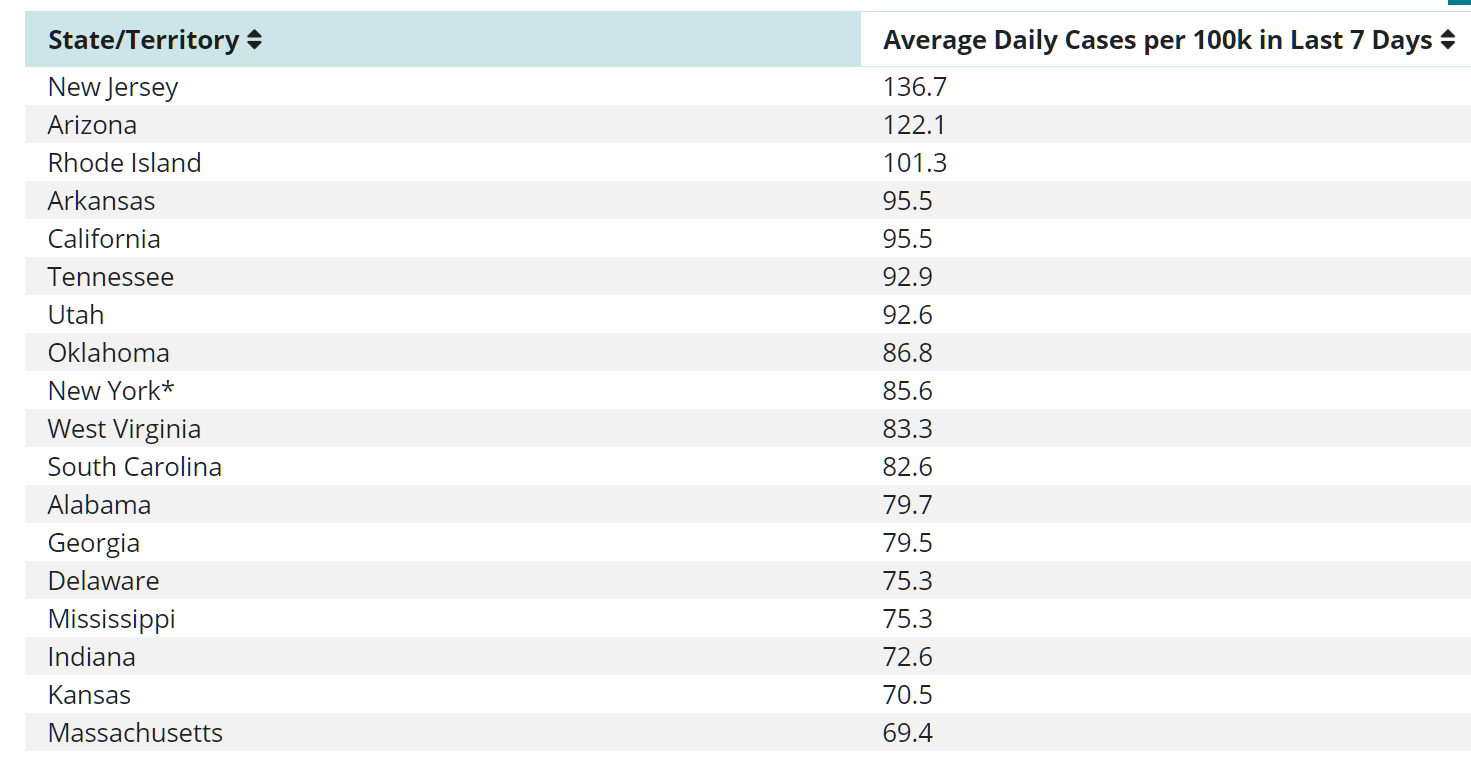
Today’s plague map from the CDC (cases within the preceding week/100,000 population):

The righteous of California were the 4th most plagued Americans, with 101 daily cases per 100,000 (averaged over the preceding 7 days). Wicked mask-denying never-shut South Dakotans? 66/100k. Righteous masked-and-shut folks in Maskachusetts? 68/100,000. Trump voters in Florida? 50 cases per 100,000.

Californians, in other words, are proving the Swedish MD/PhDS right, i.e., continental non-Asian countries can shut down if they want, but they probably won’t be special when the final stats are tabulated.

Who wants to bet on the number of U.S. media articles that will point out that the California current case rate, despite more than half a year of masks, exceeds that of no-mask-order South Dakota or that of no-masks-at-all Sweden?

Related:

Full post, including comments