Prepare for a worldwide market crash
I had some cash sitting in a checking account due to selling our house in Maskachusetts and becoming a renter here in the Florida Free State (a relocation analysis). If this had happened a few years ago, I might have let the money sit in checking until the day when it is time to get super extra stupid again and buy a house here in Florida (trade “call the landlord and open the door to the maintenance guys one hour later” for “spend a week begging contractors to come over”). But with inflation for the stuff that we might actually buy, e.g., houses, aircraft, etc., running at 20 percent annually, “park it in checking” didn’t seem viable.
I didn’t have enough confidence in the U.S. dollar or the Democrats’ muscular central management of the economy to buy more U.S. stocks. Buying bonds seems literally crazy given that the interest rate is lower than the official inflation rate. Buying TIPS doesn’t seem wise given that they’re pegged to the official inflation rate, which is way lower than the inflation rate for our family. So… that leaves non-U.S. stocks. The euro seems to have some of the same inflation risks as the USD, with governments using the same logic that Americans used from 1961 through 1975 with respect to the Vietnam War (“if we just throw some more cash at fighting this enemy, we cannot be defeated”; the enemy today, of course, is SARS-CoV-2).
But my beloved Sweden has its own currency! And that currency is up quite a bit against the euro (i.e., of course I am late to the party!):
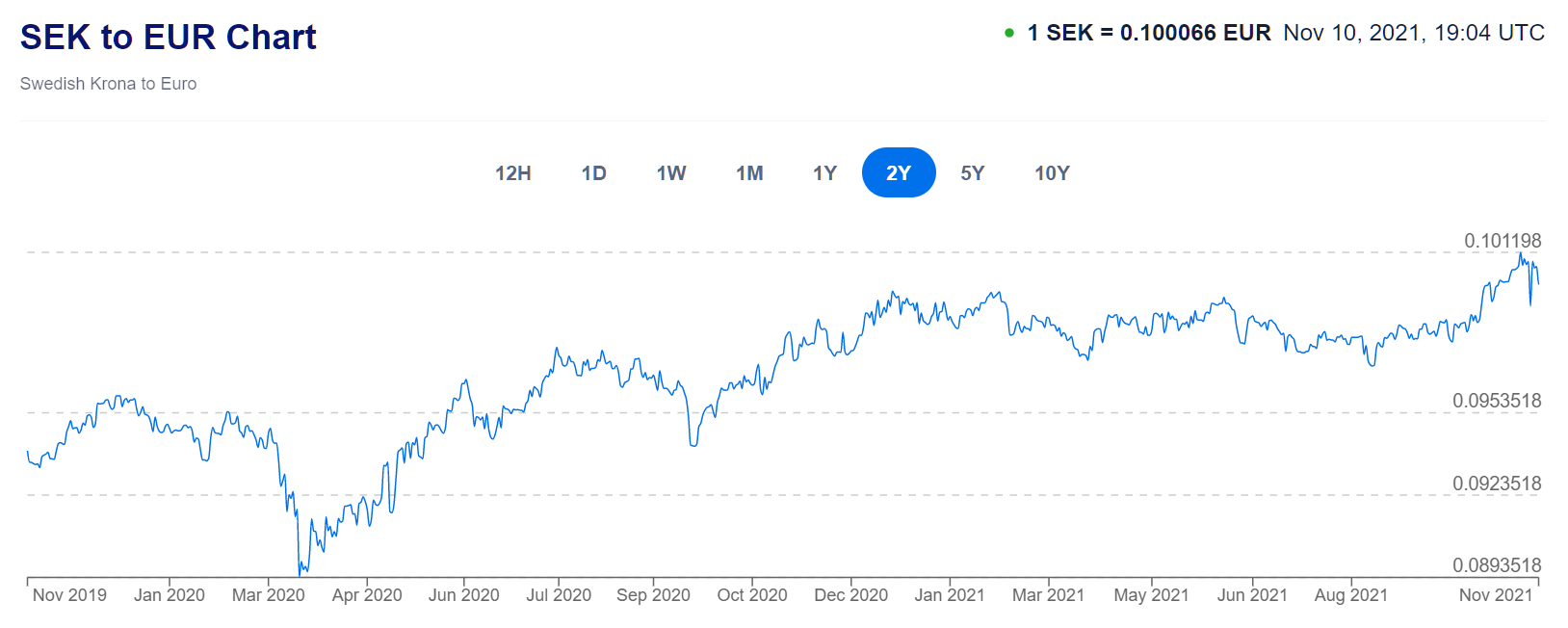
(The dollar has lost roughly 10 percent of its value against Swedish krona as well.)
From Best way to invest in Sweden? (September):
I do think the Swedes will prosper in the long run due to superior mental health, a focus on something other than COVID-19, their kids having an extra year of in-person school compared to kids in U.S. cities, etc. I want to invest in Sweden with a 10-20-year horizon.
I have now put my money where my mouth is. The house sale proceeds are, as of today, in EWD, a high-fee index fund of Swedish stocks that I never could figure out how to buy directly as an American.
However, since I am the world’s dumbest investor, if I have moved money from cash to stock that can only mean one thing going forward: a worldwide stock market crash (or at least a crash in the Swedish market and/or currency!). You have been warned!
In the best tradition of Wall Street, if this investment outperforms, I will claim credit as a farsighted genius, second only to Mileva Marić, who explained the photoelectric effect, Brownian motion, and formulated the special and general theories of relativity. If this investment underperforms, I will say that it is my version of Environmental, Social and Governance (ESG) Investing, in which I support a society that had the courage to carry on educating children, working, socializing, breathing without masks, etc. despite recognizing that COVID-19 would kill some people (albeit at a much lower rate than in a lot of countries that were celebrated for their mask and shutdown orders). The Swedes even managed to get through 2020 and 2021 without the marijuana that California and Massachusetts governors/covidcrats deemed “essential” (“Cannabis in Sweden is illegal for all purposes.”).
Readers: What are doing right now for protecting savings from Bidenflation?
Related:
- “Annual inflation hits 30-year high” (The Hill, today): The consumer price index (CPI), which tracks inflation for a range of staple goods and services, rose 0.9 percent last month and 6.2 percent in the 12-month period ending in October, the highest rate in the U.S. in 30 years. Analysts broadly expected the CPI to rise by 0.5 percent last month, up from a gain of 0.4 percent in August, and 5.8 percent over the past year.