The $70 billion travel sports industry (rich whites and Asians getting their kids into college)

Playing to Win, a short Michael Lewis book that is free to listen to for Audible subscribers, is a fascinating look into a strange corner of the U.S. economy: the $70 billion/year travel sports industry.

The primary motivation for kids’ travel sports is the parental desire for their children to get into elite colleges, which may reserve 25-33 percent of their spots for recruited athletes. (I.e., white privilege permeates America, but it is available only to whites with degrees from elite universities). The statistics that we see for selective university admissions lump together athletes and non-athletes. The chance of a white or Asian child getting into without an athletic coach’s recommendation is actually worse than the statistics suggest.

What does it cost? Lewis describes the typical athlete starting at age 11 or 12 and the parents spend $20,000 to $30,000 per year (plus a huge amount of time driving, flying, and spectating). In other words, at least $150,000 of which a small percentage might be recouped via an athletic scholarship. These costs mean that only one sport remains open to the half of Americans whose families are below the median income: football. This is because football is the only sport in which the good teams remain associated with public high schools. Travel sports is how upper-middle-class and rich whites/Asians compensate in a world where college admissions starts with a sort-by-skin-color and victimhood status.

Can individuals tap into this river of cash? Oh yes! The best is volleyball. Lewis describes a volleyball coach who organized a weekend tournament and made $1 million renting a convention center and filling it with nets. Sports for “girls” (however that term might be defined) are better than sports for athletes who identify as “boys” because the parents of the “girls” are less likely to allow the “girls” to travel unsupervised. At least one parent comes along with the athlete and books an additional hotel room then buys a ticket to the event. From the leagueapps.com web site, a presumably typical document requiring participants to book their hotels through the event organizer:

(LeagueApps says that they have processed more than $1 billion in payments.)

Lewis’s own daughter gets into the liberal arts college of her choice after a softball coach watches her play. What is a stressful admissions process for her classmates is a brief conversation with the coach in the spring of her junior year of high school.

Recommended.

Full post, including comments

Experience with One Medical?

As Toucan Sam likes to remind us, Barack Obama said “If you like your doctor, you can keep your doctor,” but our new insurance company apparently did not get the Presidential memo.

It is thus time for me to shop for a new physician. The new insurer assigned me to a doctor, but after a couple of hours on hold with the big clinic where he works, I learned that (a) he isn’t accepting new patients, and (b) he is mostly retired.

One Medical has a couple of offices here in Boston and claims to be patient-centric rather than insurance-company-centric. Does anyone have experience with this concierge-lite primary care system? (it is $200/year, which is a lot better than waiting on hold for hours!)

Update… part of the sign-up form:

(I decided to sign up based on positive reviews from people here and also a friend who drives 30 minutes from the Boston suburbs to continue his treatment at One Medical. As readers can no doubt imagine, it was tough for me to resist entering a long essay into the Gender Information box. And, then, of course, I had to de-subscribe from One Medical after it turned out that they accept Tufts insurance, yes, but not the particular flavor of Tufts “Platinum” that we have.)

Related:

Full post, including comments

How does HIPAA interact with state governors’ demands for COVID-19 test results?

Today is National Pearl Harbor Remembrance Day, marking 79 years since we entered World War II in order to fight Totalitarianism.

Here in Massachusetts, as part of our governor’s more-than-50 orders, we are required to tell the government, via a web form, about any travels that we might have undertaken. And “Quarantine for 14 days or produce a negative COVID-19 test result that has been administered up to 72-hours prior to your arrival in Massachusetts.”

From mass.gov:

72-hour Testing Rule: The individual can produce, upon request, proof of a negative test result for COVID-19 from a test administered on a sample taken no longer than 72 hours before your arrival in Massachusetts.

So we’ve spent hundreds of $billions (software, time spent with forms) for our medical records to be protected by HIPAA (federal law), but the state can demand a portion of our record via a “request” (fine of $7,000 if one fails to comply with the “request”; see the governor’s 45th order).

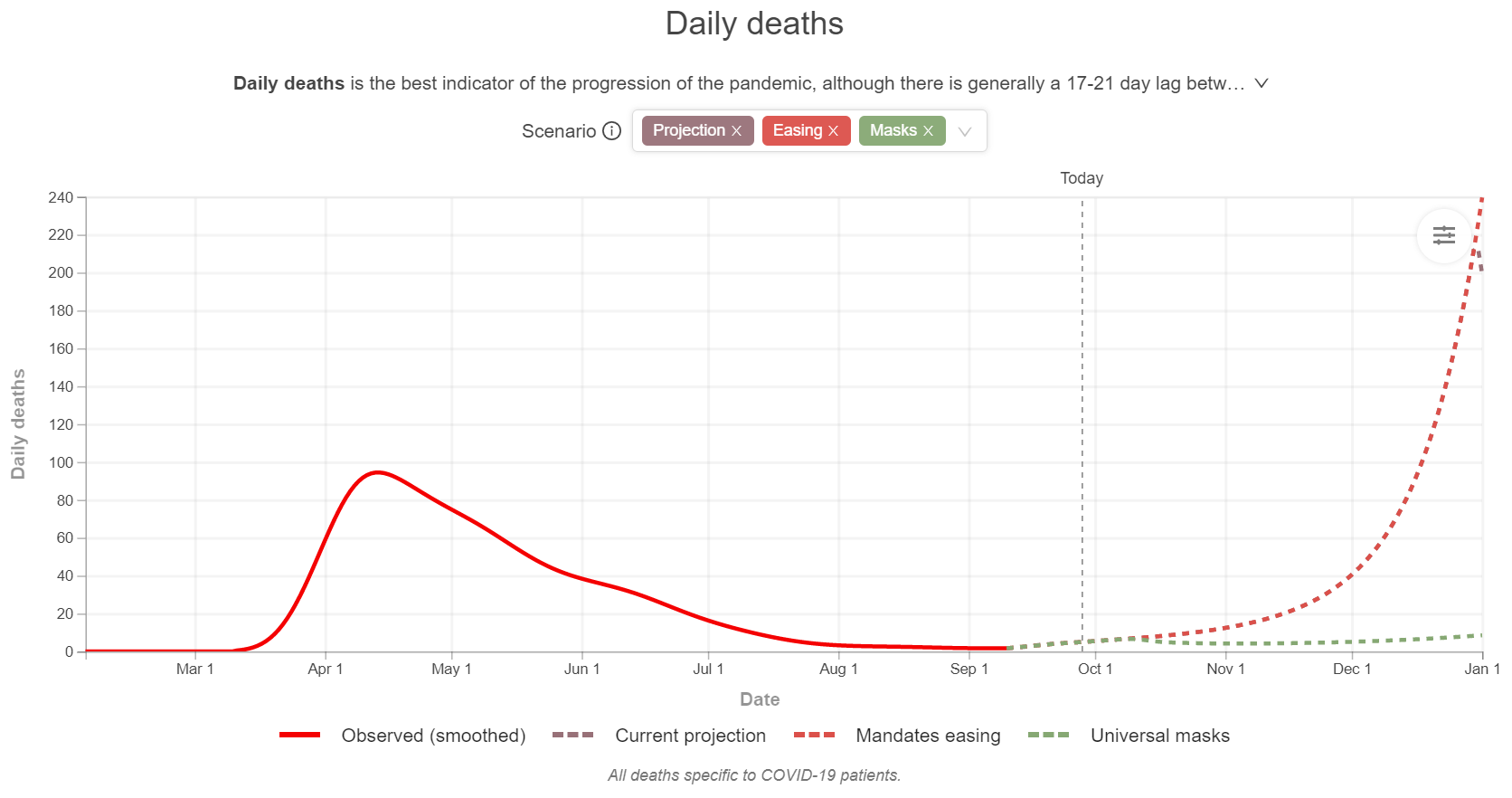
Plainly the Shutdown Karens can say that this is quite reasonable. The governor has declared an emergency so the state government should have access to whatever is necessary to deal more effectively with that emergency (never mind that test and trace immediately fell apart, so this information is useless, or that the typical person is not contagious by the time a test has been scheduled and result received (NYT)). But, on the other hand, a governor can declare additional “emergencies” any time that he/she/ze/they wants to. Obesity kills far more Americans than COVID-19. Couldn’t a governor declare an obesity crisis and demand that people submit medical records related to obesity and diabetes? We’re already in an opioid crisis, right? Why shouldn’t the state have the right to “request” your prescription records to make sure that you haven’t been getting too many OxyContin pills? (and fine you $7,000 if you fail to comply with the request)

Very loosely related, a conversation with a 5-year-old after putting a e-collar on our golden retriever to prevent her from scratching at a scab:

  • Me: Mindy doesn’t like wearing this collar.
  • Child: Why not?
  • Me: Even a dog can tell when her liberty is taken away.
Full post, including comments

Health care workers in Aruba plead with you to stay home and avoid travel

“Health Care Workers Plead With Americans To Take Pandemic More Seriously” (NPR):

Health workers and hospitals already strained by the pandemic are increasingly making direct appeals to the public with open letters, asking people to mask up and stay at home this holiday season.

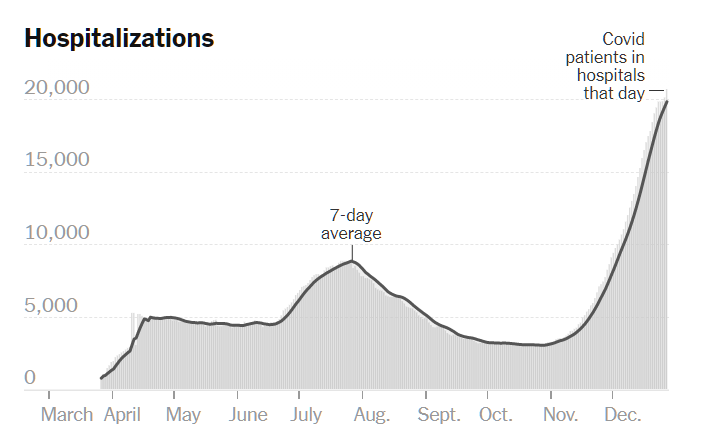
I was chatting this evening with our stealth author of Medical School 2020. He’s working 12-hour shifts at a hospital where roughly 8 percent of the beds are occupied by COVID-19 patients. “Remember that if someone comes in with appendicitis and happens to test positive, they become a ‘COVID-19 patient’ in our census,” he said.

How seriously do frontline health care workers take the pandemic? Our mole in the system described a doc and nurse couple electing to take a mid-November vacation in Aruba. They got on a flight that was 100-percent full, thus voluntarily spending hours sharing a narrow cylinder of air with 150+ other humans. When they got off the plane, they were subjected to screening questions by the Aruban authorities. Instead of admitting that they worked in a hospital every day, they said that they “worked in biochem.” On reaching the (packed) resort, they said “The majority of the other guests were health care workers” (i.e., there were additional hundreds of doctors, nurses, etc. who had chosen to take the risk of contracting COVID-19 at the jammed airports or on the full flights).

(Separately, should COVID-19 patients be in the hospital to begin with? It is not like having a heart attack or getting into a car accident where the doctors have effective treatments to offer. Why aren’t they at home with an oxygen bottle and a CPAP machine or high-flow nasal cannula? A med school professor friend:

Many things could be done from home cheaper and safer but we don’t have the infrastructure or culture. Home model kills the rationale for the hospital cash cow.

Our Medical School 2020 author:

I agree that outside of severe Covid, most of the interventions can be done at home — we send patients home with up to 5 L O2 for bad COPD. It somewhat reminds me of the slow transition from inpatient to outpatient management for other conditions, e.g., deep ventous thromobosis (“blood clots in the legs”) that now is managed with oral blood thinners at home instead of in the hospital. … There are really only a few interventions that we do for covid19 — low and high flow oxygen supplementation, noninvasive (think CPAP) or invasive mechanical ventilation, steroids (actually a good intervention for mechanically ventilated patients — 30 vs 40 percent 1-month mortality) and remdesivir (only benefit shown in low O2 patients with decrease in hospital stay of 10 vs 15 days in small study). … I agree that the only difference for non-severe covid infections between home versus inpatient is just getting telemetry monitoring and daily labs in the hope of catching worsening pulmonary function or prognostication of the weird complications of covid (e.g., heart attacks, blood clots). Unsure of our prognostic ability to guess who will worsen versus who will improve early on in the course (uptodate states the shortness of breath from covid19 occurs up to 8 days after symptom onset). Perhaps utilizing some Apple Watches and Fitbits over those 8 days might save some hospital beds.

See “A Covid-19 Lesson: Some Seriously Ill Patients Can Be Treated at Home” (NYT, July 18) for a story about a hospital that innovated.)

Is #StayHomeSaveLives the new #TakeTheBusSaveThePlanet? Classically, everyone agrees that it would be a good idea if other people took the bus or the subway, thus reducing traffic congestion and pollution.

From the official Aruba tourism site:

(I would love to go right now, but despite my reputation for skepticism regarding coronapanic, I would not voluntarily get on a commercial airline with all seats full.)

Related:

Full post, including comments

Why not heated furniture to fight coronaplague?

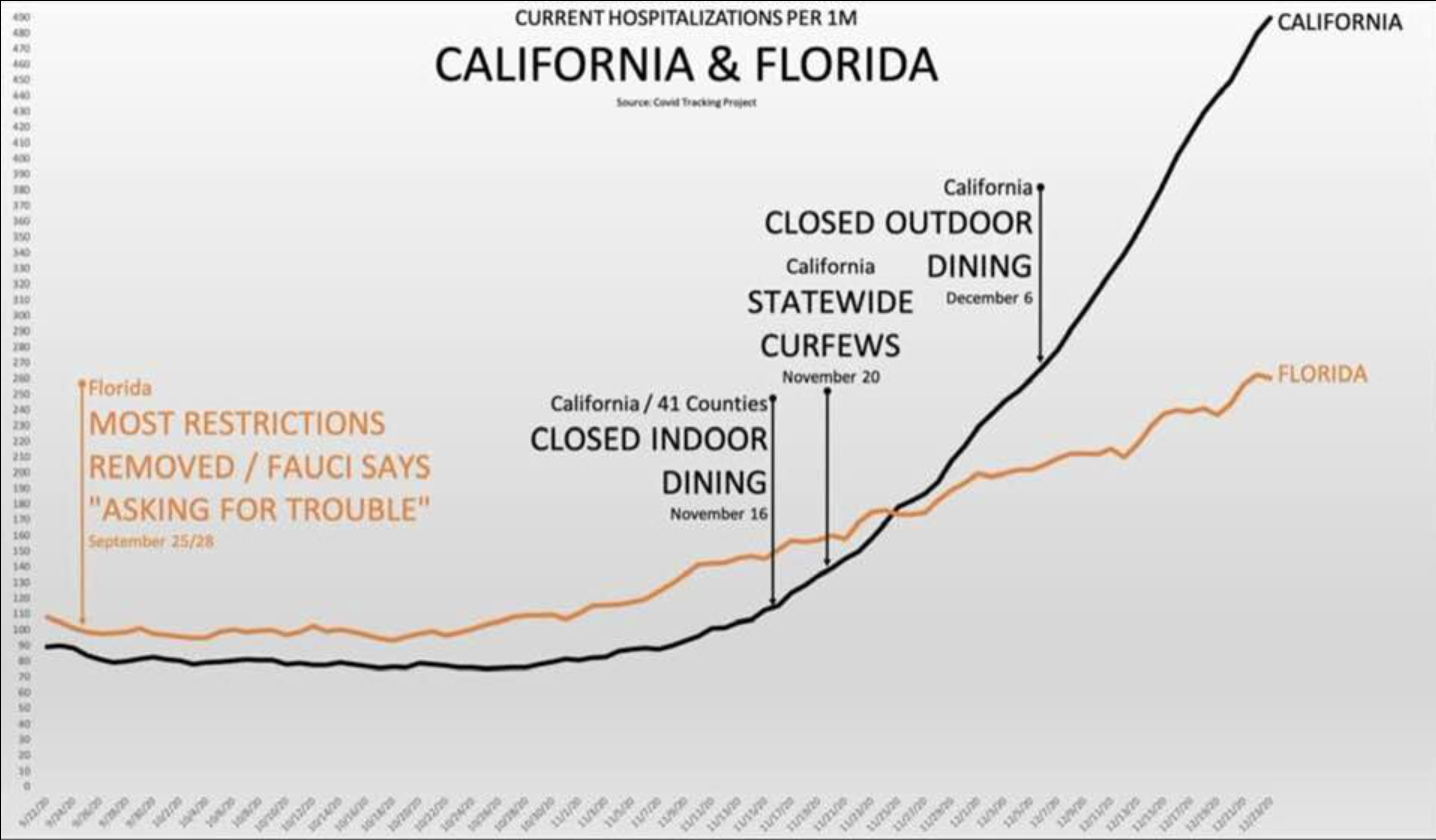
In their righteous muscular efforts to “control” coronavirus, some state governors and city mayors have ordered restaurants shut down, except for outdoor dining. In response, restaurants have built four-sided tents filled with CO2-emitting propane heaters. It is unclear why this is different from being indoors, other than the lack of a real HVAC system. The tent sides are necessary, though, because otherwise the propane heat will blow away.

Why not heat the customers instead of the air?

Back in 2010, I wrote Heated Furniture to Save Energy?

A lot of cars have heated seats. When the seat heater is on, most drivers will set the interior temperature 3-7 degrees lower than with the seat heater off. Why not apply the same technology to houses?

Imagine being at home in a 65-degree house. Even in a T-shirt and jeans, it would probably be comfortable to walk around, stir a pot on the stove, carry laundry, scrub and clean, walk on a treadmill while typing on a computer (as I’m doing now!). However, if one were to sit down and read a book, it would begin to seem cold. Why not install heat in all of the seats and beds of the house? And sensors to turn the heat on and off automatically? In a lot of ways, this would be more comfortable than a current house because the air temperature would be set for actively moving around while the seat temperature would be set for sedentary activities.

There is a fine line between brilliant and stupid, of course, but could it be that coronaplague has pushed this idea over the line?

A Dutch company, sit & heat, seems to have thought of this: heated cushions that can fit into a standard frame. Serta makes a chair-shaped electric quilt (could not survive outdoors) for only $64. A plastic chair with a built-in 750-watt heater is $900 (Galanter & Jones; they have sofas too at roughly $6,000 and claim they are “cast stone”).

If heated chairs were mass-produced in Asia, presumably the cost per chair would be only about $100 more than a regular outdoor chair. That should be affordable for a restaurant.

Related:

Full post, including comments

Does disinfectant theater contribute to coronaplague?

Text message exchange with a couple of 24-year-olds:

  • Me: We can come over now.
  • Them: We are at the gym!
  • Me: You’re always there. I am amazed you haven’t gotten coronaplague yet!
  • Them: Hahaha I know! The gym we go to is super clean.

Surface contamination has been ruled out as a significant source of coronavirus infection, right? (see below, however, for how cleaning can cut flu risk by 2 percent) Everyone agrees that it is now mostly about aerosols and therefore a gym is a perfect environment for spreading, yes? (People breathing hard and relying on non-N95 masks and/or bandanas as PPE.)

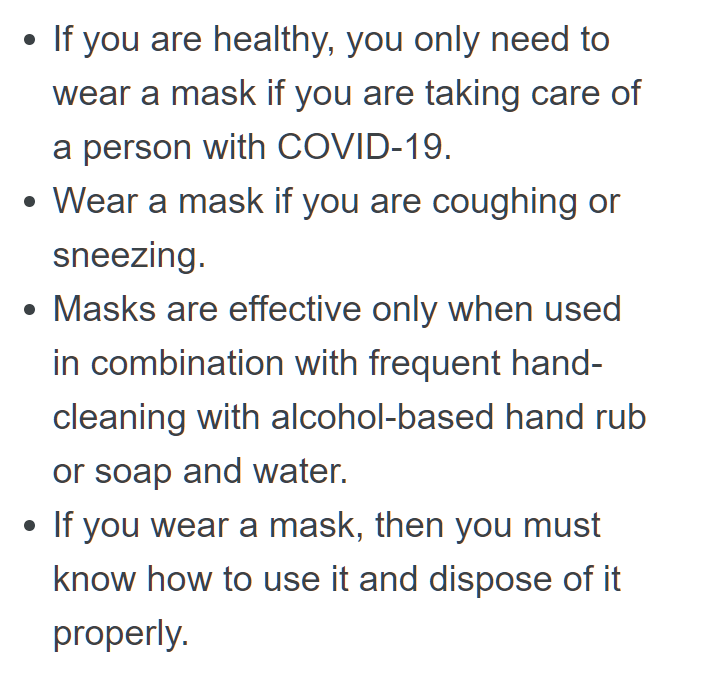
Masks make people complacent and prone to ignoring instructions to keep a 6′ distance. I wonder if the sight of workers with spray bottles and paper towels has the same effect. These 24-year-olds feel that they are significantly less likely to get infected because they’ve seen every surface being wiped, despite the fact that wiped surfaces are irrelevant when faced with an aerosol enemy.

Related:

Full post, including comments

Almost as scary as coronavirus: the Vendée Globe this year

Previously on this blog: Godforsaken Sea, a book about a round-the-world solo yacht race.

This year… “‘Just terrifying’: Vendée Globe sailor rescued after yacht breaks in half” (Guardian):

“I didn’t have time to do anything,” said Kevin Escoffier. I just had time to send a message to my team. I’m sinking, I’m not joking. MAYDAY.”

Escoffier, 40, the French sailor who was lying in third place in the Vendée Globe solo round-the-world race, was talking after his dramatic rescue. On Monday afternoon, 840 miles south west of Cape Town, in strong winds and heavy seas, his 60ft carbon fibre boat PRB slammed into a wave at 27 knots and broke in half. PRB is one of the latest generation Imoca 60s with foils to lift it up so that it is practically flying. Escoffier abandoned ship and took to his life raft.

Escoffier was at 40°55′ S, 9°18′ E (source), confirming the old saying:

Below 40 degrees south there is no law;
below 50 degrees south there is no God.

Full post, including comments

Immigrant Dad’s tutorial on the “real hidden figures” in Hidden Figures

The local 9th graders were sentenced to watch Hidden Figures by their English teacher. Immigrant Dad’s running text message commentary:

Watching the movie “Hidden Figures” about Black women at NASA. About how they created the space program for us.

I stopped the movie to say that the real hidden figures were 1600 Nazi scientists, led by Werner von Braun, the SS Sturmbannführer [major] who basically did everything.

All white males.

Aryans.

In this movie, von Braun is nowhere to be seen despite scenes with Alan Shepard and NASA top brass

Can’t afford to have an SS guy in this poetic script.

Black women all coding now. And teaching white men how to do it.

This whole film was a giant waste of time.

I need to help my kid write a paper referencing this work of woke art. I am teaching them how to feed idiots what they want to hear. Useful in life.

Another friend chimed in:

The scene where Harrison smashes the Colored Ladies Room sign never happened, as in real life Katherine refused to walk the extra distance to use the colored bathroom and, in her words, “just went to the White one”

A Silicon Valley coder in the chat group:

These ladies make money in a more civilized manner: https://youtu.be/hsm4poTWjMs (featuring Joe Biden’s friend Cardi B). Those fingernails are like Chinese foot binding, they say, “I am too important to do a ghetto job like programming.” Remember that the black struggle was all about getting off the plantation; why go back to it with all the Indians and people on the autism spectrum? [black power fist emoji]

I’m not sure that the youngsters learned what the teacher was hoping they would…

They are watching and making fun of it. Especially black women programmers. In [one kid’s] view Blacks are as rare in computer science as whites in basketball.

How does Immigrant Dad’s history lesson hold up? Wikipedia:

Operation Paperclip was a secret program of the Joint Intelligence Objectives Agency (JIOA) largely carried out by special agents of Army CIC, in which more than 1,600 German scientists, engineers, and technicians, such as Wernher von Braun and his V-2 rocket team, were taken from Germany to the United States, for U.S. government employment, primarily between 1945 and 1959. Many were former members, and some were former leaders, of the Nazi Party.

Some January photos from the Kennedy Space Center. Note that programmer Margaret Hamilton is depicted larger than life size, while Werner von Braun is at 1/10th the scale. (The photo on the bottom is captioned “The Original Mercury Seven Astronauts with a USAF F-106.” Alan Shepard is among them. They are but midgets next to Margaret Hamilton.)

And this is a good time to reprise my heroic Cirrus SR20 landing on a 15,000′ runway (same trip):

Also a good time to remember our hosts down there, Al Worden, who sadly died just 6 weeks later despite seeming to be in perfect health, and Bruce Melnick, helicopter pilot-turned-astronaut.

Related:

Full post, including comments

Robinson R44-based gender reveal

From the always-fascinating Nicole Vandelaar Battjes (previously featured here)…. a gender reveal event that stars a Robinson R44 helicopter.

(I love Nicole so much that I refrained from commenting that the child’s actual gender would not be known until at least 2039 or later.)

Very loosely related, a Hawaiian sunset captured on 6×6 film in the late 1980s…

Full post, including comments