How is coronaplague down in Brazil? (and the rest of the IHME predictions)

Yesterday was August 4, 2020, the date on which the IMHE prophecies were supposed to be proven out. Let’s see how the reality compared to the June 10 prediction. In “Wicked Brazilians will take the place of the wicked Swedes in forecasts of doom?” (June 13) I noted that 5,248 Brazilians were forecast to be killed by Covid-19 yesterday.

What does WHO say about the actual number? It was 541 yesterday (August 4), 1,088 the day before (August 3), 1,212 on Sunday, August 2, 1,129 on Saturday, August 1., and 1,595 on July 31. Here’s my prediction in full:

My perspective is a “scientific” one. In other words, I will look at one or two data points and then extrapolate wildly. From the chart below, it looks like the non-virtuous Brazilians have, by dint of doing nothing, already “flattened the curve” to a large extent. So my first scientific observation (i.e., guess) is that the death rate on August 4, 2020 will be roughly the same as it is today. On the other hand, the virus has already killed a lot of the easiest-to-kill Brazilians. Therefore, the number should be a little lower. On the third hand, General Winter is fighting alongside the coronavirus in parts of Brazil. If the latter two factors cancel out, the number of deaths tagged to Covid-19 in Brazil on August 4 should be 1,274 (the number from yesterday’s WHO report).

Summary of the above: prediction of a plateau and therefore 1,274 deaths yesterday. So I’m off by more than 2X for the actual number, but the latest graph from IHME (a smoothed curve) does look vaguely plateau-esque, so perhaps I can claim victory on the shape?

Alex guessed 1,219 following YouYang Gu’s model. ajm did an interesting analysis starting from the Diamond Princess data and came up with 1,800. Henry went with IHME, but cut their 5,248 estimate by 50 percent due to his faith in the Sacrament of Masks. Sig came up with a technical analysis approach, as they say on Wall Street:

I think the pattern is quite clear here: after the peak it is a log-linear descent, with always the same slope. No need for science or following news… (Italy has a step there, they probably transitioned to a different counting method.) So, extrapolating for Brazil, which looks like being at the peak, to 130 days, which would be beginning of August in that case, and adjust for population, I arrive at 300 “daily new confirmed COVID-19 deaths”. Turns out SK already bet that, so I’ll go for 299.

The winner… SK! “My assumption it will fizzle our even more. My prediction is 300. Definitely less than 900.”

So… IHME was off by 10X (but maybe only 5X if we smooth the data?). I was off by 2.5X. When is it time to acknowledge that the virus is smarter than we are?

How about the rest of the IHME predictions? Back in April they were predicting 13,259 deaths for Sweden by August 4. The WHO figure from yesterday’s report is 5,744 (i.e., off by 2.5X). The same April post carried a prediction of 6,739 deaths for Massachusetts through August 4. That was without the assumption that the state would adopt universal masking. We did mask up and… the actual number was 8,436 (mass.gov).

In late March, IHME predicted 80,000 deaths for the U.S. through August 4, 2020, with a 95% confidence interval of 40,000 to 160,000. The WHO report number is 154,226. So they were off by almost 2X, but not so far off as to call their methodology into question.

Related:

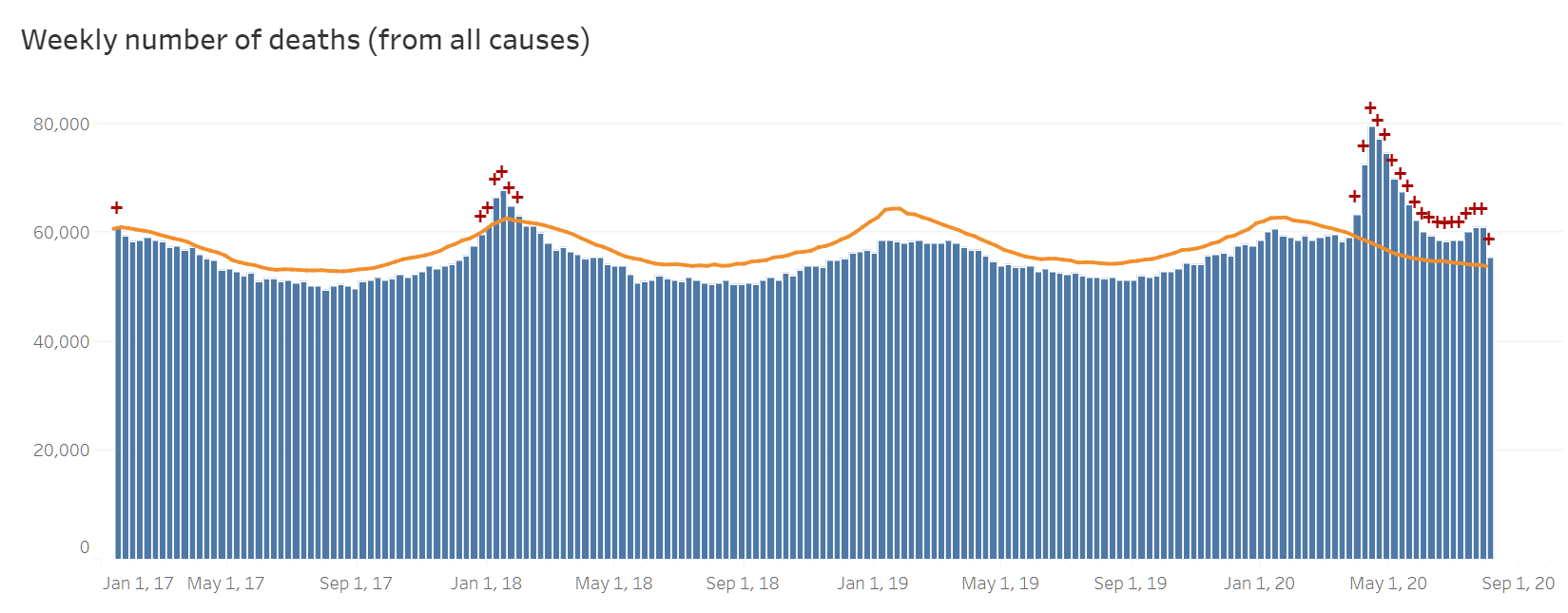
An update of the big chart from the previous post:

Full post, including comments

Nobody cares about the Beirut explosions?

When there is a massive explosion in the middle of a city of more than 2 million people, you might expect people around the world to be interested. Certainly that was true in 1917 when, despite World War I going on, people were interested in the Halifax Explosion (see “City rebuilding costs from the Halifax explosion” for some excerpts from a good book on the subject).

Some graphics from the NYT, taking a rare break from Trump hatred:

Let’s consider my Facebook feed as a good proxy for what the coastal righteous care about. None of my friends care about this explosion! Here is a list of topics from the past few hours:

  • Covid-19 will permanently damage everyone whom it infects, even if it doesn’t kill everyone
  • Trump appointed an anti-abortion person to something
  • whether flight instructors should work in the age of Covid-19 (posted by a Shutdown Karen CFI)
  • Trump struggles to say ‘Yosemite’ at White House speech
  • various articles about whether America’s unionized public school teachers can be forced to work and whether America’s non-unionized private school teachers can be forced to not work
  • exhortations to wear masks more and “more better” (covering the nose, for example!)
  • 2015 Tianjin explosions (loosely related!)
  • “So far 2020 is like looking both ways before crossing the street and then getting hit by an airplane” (a meme that could apply to Beirut!)
  • a post about how Republican leadership is bad for the U.S. economy
  • stuff about what will happen when Trump refuses to leave office in January 2021 (with opinions by “experts” on the subject of something that has never happened, i.e., a U.S. president refusing to hang over the reins)

Is it fair to say that Covid-19 primarily affects the mind? Americans (nearly all of my Facebook friends are American) no longer think about anything but their personal welfare with respect to Covid-19 (the Trump-related stuff counts because these people believe that the Great Father in Washington can determine whether or not they are infected).

Related:

Full post, including comments
If K-12 schools will be online-only, why not start right now?

“Most California Schools Unlikely To Open In Fall Under New State Rules” (NPR):

Most California schools may remain closed when the academic year begins in the fall, according to new state directives, with a majority of campuses likely having to shift to distance-learning instead.

The new requirements stipulate how and when schools may reopen for in-person learning when the academic school year begin. … Under the new rules, a county must also not be on a list of counties being monitored for rising coronavirus infections. Thirty-two of the states 58 counties currently don’t hit that benchmark. To open schools for in-person instruction, those counties would have to be off that list for 14 consecutive days, according to the directives.

The directives are on the heels of announcements that some of the state’s largest districts had already decided to enter the academic year with no in-person classes. Los Angeles, San Diego and San Francisco all recently said they planned online-only learning when students returned.

This makes sense for a population whose only goal in life is avoiding Covid-19 infection. But why wait for the fall? Given that students already missed a lot academically during what would have been the spring semester, wouldn’t it make sense for K-12 to start up right now for any student who wants to try to catch up? Supposedly, the schools and teachers that did a lame job with online education in June will be doing an awesome job in September. But why not start with the awesomeness tomorrow, for example?

Related:

Full post, including comments
Academic study of virtuous victimhood from the immorality lab

“Signaling virtuous victimhood as indicators of Dark Triad personalities.” (Journal of Personality and Social Psychology, full text available):

The cry that one is a victim of injustice, oppression, intolerance, or any of the myriad reasons why people believe they are prevented from getting what they want in life has echoed loudly through the ages. It remains so today. … we propose that claiming victim status, an act we refer to as victim signaling, also allows victims to pursue an environmental resource extraction strategy that helps them survive, flourish, and achieve their goals in situations that are responsive to their claims. By resource extraction we mean that resources are transferred from either individuals or larger institutions (e.g., the state, organization) to the person who signals victimhood.

The obligation to alleviate others’ pain can be found in most of the world’s moral systems. It also appears to be built into the structure of the mind by evolution, as evidenced by the human tendency to feel distress at signs of suffering. It is therefore not surprising that many people are motivated to help perceived victims of misfortune or disadvantage

The four authors come from the University of British Columbia’s “Immorality Lab”:

The Immorality Lab was created in 2009 at the campus of the University of British Columbia in affiliation with Sauder School of Business and the Faculty of Psychology. The purpose of the lab is to unite a virtual community of international scholars who study the many ways people mistreat one another and contribute to the sum total of misery and unhappiness in the world.

The head of the lab describes himself as “A Leader who sets no example and “High School Graduate (w/o honors)”.

How is it possible that the Canadians are studying immorality? These are the people who have promised to take every low-skill migrant whom the U.S. rejects? (see “Why accept any refugees to the U.S. if they are welcome in Canada?” and “Can the refugee caravan at the U.S. border simply fly up to Canada?” (in which offered to spend $50,000 of my own funds to deliver migrants to Vancouver, but the Canadians did not accept the offer)) In fact, they don’t even use the word “migrant” or “immigrant,” but rather “New Canadian” or “new citizen”.

Shouldn’t an immorality lab be centered in a U.S. state that voted overwhelmingly for Donald Trump?

Maximum virtue on display, captured in some photos during a now-illegal trip to Toronto in March 2019:

Related:

Full post, including comments

Karen’s Mask Report from Maskachusetts

In early June I posted “Karen’s Mask Law Compliance Update (Boston to Minneapolis and back)” (this trip plus a trip to the local supermarket would now be illegal under the new Maskachusetts rules!). Here’s an update based on a rare day out and about.

When not filled with arguments about how to pay for the most expensive (per student) school ever to be constructed in the United States, our righteous suburb (rich in BLM and Rainbow flags, if not in people who identify as persons of color or members of the LGBTQIA+ community) is filled with arguments about the best approach to coronapanic. The latest furor concerns the lethal Covid-19-spreading properties of Canis familiaris. Touched someone else’s dog? Dig yourself a grave. A proposed solution is that our town will one day see reason and pass a leash law to reduce the chance of human-canine encounters.

Thus, it was with some trepidation that I took Mindy the Crippler for her first post-plague visit to the grooming salon. If our neighbors are right, the groomers should all be dead. Folks in the salon apparently did not get the memo regarding the hazards of touching dogs and, remarkably, have failed to die on schedule. While Mindy was having her spa treatment, I met a couple of friends for a rare indoor dining experience at a Panera-style restaurant (order at counter; food delivered to table). They have failed to adapt to coronaplague by augmenting the handful of outdoor tables and it was super hot outside so we ate indoors.

We’re in Month 5 of shutdown here and Month 3 of the universal mask law. Everyone seemed to be attempting to wear masks, but, just as the Swedish MD/PhDs predicted, once they were masked they made little attempt to keep a 6′ social distance. There were a fair number of masks-under-noses as well. We’re spending $trillions on things like $600/week handouts to people who became unemployed after the License Raj made it illegal to operate restaurants. But there doesn’t seem to be any money for adaptions that would contribute to long-run plague reduction (like my pet idea for schools). For example, cruise ships usually have handwashing sinks near the entrance to restaurants. Not this restaurant. If we believe the W.H.O. guidance on mask usage (early June 2020 edition of “science”!), the restaurant should have had a sink outside near the outdoor tables and an indoor sink that didn’t require going into a restroom. After all, masks are effective only when combined with handwashing, so we were told by W.H.O. But, in fact, there were no sinks for customers other than ones in the restrooms.

I took Senior Management’s car for a state inspection on the way back to the groomer. None of the guys at the gas station were wearing masks when working in the bay or outdoors, but put them on (without washing hands!) when going inside the shop to run credit cards with customers.

Mindy wasn’t quite ready, so it was necessary to kill time at Dunkin’ Donuts. The women behind the counter were both wearing masks… underneath their noses. Then the hardware store to buy three bottles of drain cleaner to address a slow kitchen sink. “Why do you need three bottles?” asked the partially masked woman in the store? “One thing I have learned from our government is that when something doesn’t work, keep repeating it over and over.” (The grease clog and a small leak in the elbow were eventually solved by a plumber for $370, further evidence that owning property in the U.S. is stupid, except for the exceptionally capable who can do everything themselves.)

A Sunday trip via Cirrus to Martha’s Vineyard (one of the few places to which Maskachusetts residents can legally travel to/from) showed that the island is all-in on masks (“Wear a Mask, Make a Difference” says the sign, contradicting the W.H.O.’s advice through early June and the MD/PhDs in Sweden):

Note the mask directives for boarding the ferry to Chappaquiddick. Perhaps if Ted Kennedy had worn a mask, American politics would have gone in a different direction! (my Cape Cod photos include historical photos of the inn where Teddy K stayed and the motel room where Mary Jo Kopechne stayed).

Two miles away…

I still wonder if having customers inside retail stores makes sense in a country where the only goal is avoiding COVID-19. As noted in “Train Americans to use masks the way that surgeons do or restructure the physical environment?”, why can’t stores go back to their 18th century roots: Customer enters spacious front part of shop and asks for item. Shopkeeper goes into jammed back part shelves to retrieve requested item. (tweak so that customer never goes into the store itself, but stays outside and transacts business over a counter)

We’re afraid of getting Covid-19 from surfaces, right? (hence the constant sanitizing) We’re also afraid of getting Covid-19 from sharing air. How can it make sense to put the entire country at risk by continuing to operate retail stores as they were configured in the pre-Covid-19 age?

Related:

  • “Masks are pointless, says Sweden’s maverick chief medic” (Financial Review): “Because from a medical perspective there is no proven effectiveness of masks, the cabinet has decided that there will be no national obligation for wearing non-medical masks,” said Medical Care Minister Tamara van Ark. (Where is the respect for #Science?)
Full post, including comments

Psychologists struggle to comprehend the incomprehensible (Donald Trump)

A friend of a friend is a Ph.D. psychologist…

I had to take a class yesterday on “Racial and Community Violence” in order to renew my license to practice. There were only three articles used as curric[ulum].

(1) The first was regarding the mystery of why ordinary Americans support Trump. It said among other things, “Trump is an insult clown….and he is “A gold-plated buffoon who draws the enthusiastic endorsement of racists across the spectrum of intolerance, a gorgeous mosaic of haters, each of them quivering excitedly at the prospect of keeping a real, honest-to-god bigot in the White House. The Trump movement is a one-note phenomenon, a vast surge of race-hate. Its partisans are not only incomprehensible, they are not really worth comprehending.” (maybe from The Guardian?)

The second article was titled “Ferguson Isn’t about Black Rage Against Cops. It’s About White Rage Against Progress.” (Washington Post?)

The last article was titled, “The Decline and Fall of White America: Inside the Study that Shocked the Public-Health Community” (Slate?)

I got my CEUs [continuing education units?]. The class was produced and offered by The American Psychological Association. I paid them $80 for it. It is 3 hours to meet my multicultural requirement.

Full post, including comments

Why hold elections in non-swing states?

A Facebook Mask Karen (his profile picture is at least 50 percent face covering) highlighted “Coronavirus creates election worker shortage ahead of November” (Politico): “Local election authorities typically rely on older volunteers, who are dropping out in higher numbers over coronavirus fears.”

This prompted me to wonder why we would have an election at all here in Maskachusetts. Most candidates will he running unopposed. For the remainder, the outcome is already known. Why have people gather to infect each other when there is nothing to be decided?

Readers: What is the point of a November election in one-party states such as California, New York, et al.? If #BecauseEmergency is sufficient reason to cancel what used to be Constitution rights that had some value (e.g., the rights for young healthy people to receive an education, assemble and socialize, go to work, etc.), why isn’t #BecauseEmergency sufficient reason to cancel a valueless right (to vote in a non-primary election in a non-swing state)?

If we insist on some kind of count, we could do it safely with a drive-by inspection of lawn signs. Every “Hate Has No Home Here” sign can be counted as a vote fore Joe Biden:

Anyone who has the temerity to place a Donald Trump on a lawn in our town will typically find that the neighbors correct the mistake within a few days. Votes for Trump cannot therefore be via a sign with the hated dictator’s name on it. Maybe a yard sign like this would be sufficiently subtle?

Readers: What is the point of holding the November election in the states that overwhelmingly favor one party?

Full post, including comments

Security Theater intersection with Coronapanic Theater: illegal to fly over an empty stadium

The Boston Red Sox are playing in Fenway Park again, but fans aren’t allowed into the stadium. After the jihad of 9/11, the major league sports teams were able to realize their dream of blocking banner-towing airplanes from flying over stadiums. The banner-towers were competing with the teams for in-stadium advertising dollars. The dream of eliminating this competition had been out of reach for decades due to a legal/FAA doctrine that airspace belongs to the public and therefore the teams couldn’t own the airspace above their stadiums.

After 9/11, the teams got Congress to lean on the FAA to put in a “temporary flight restriction” (the temporary restriction will soon turn 20 years of age!) forbidding all aircraft from overflying within 3 nautical miles and 3,000′ (of course, a helicopter 3 miles away and at a normal helicopter cruising altitude would not really be an “overflight” since it wouldn’t be visible from the stadium). This is in the name of “security”, though it is unclear what the practical effect could be on security since the typical terrorist is already violating a variety of regulations and laws by carrying out a terrorist act.

Given that the stadiums are 99 percent empty, has the rule been relaxed? No! So we’re not allowed to do our helicopter tours over Boston (we don’t need to fly over Fenway Park, but it is quite close to the center of the city, so a Fenway TFR makes the tour essentially impossible). Families heading to Cape Cod in little planes won’t be able to take the conventional shortcut through Boston and over Logan Airport.

This was sold as a way to keep a determined jihadi from wiping out 30,000+ people with a Cessna 172 or similar (though, as noted above, it was unclear how it ever could have worked to achieve that end). But now it is being applied to ensuring security for a handful of baseball players who are all alone in the stadium.

Related:

  • “Baseball Is Playing for Its Life, and Ours” (NYT, August 2): protected from attack by family Cessnas and four-seat Robinsons, the young healthy baseball players are nonetheless besieged by a virus whose victims average 82 years of age with underlying health conditions. “Baseball was entering the war against the pandemic, and the world was positioned to benefit from the information that would be gathered. The league, armed to the teeth with power and privilege, access to testing, cash flow, precision data collection, and high-powered, lower-risk athletes playing outdoors, was supposed to prevail. … baseball and other sports will help get us there by aggressively gathering information about the risks we are all facing. In the end, this will be prove to be more valuable than anything normalcy can provide. We are playing to survive.” (i.e., we will learn more from Major League Baseball than from all of the MD/PhDs working for the Swedish government!)
Full post, including comments

Joe Biden agrees that the U.S. needs refugees… but wants to limit to 125,000 per year

“America Needs Refugees” (NYT):

The statute became the basis for the successful resettlement of more than three million refugees escaping violence and persecution. The country can take pride in that sustained humanitarianism, which has also made the United States stronger.

His first executive order, in January 2017, indefinitely suspended the resettlement of Syrian refugees, froze resettlement admissions and barred entry to citizens of seven Muslim-majority countries. Later that year, Mr. Trump announced that he was capping refugee admissions at 45,000, — less than half of the 110,000 the year before under President Barack Obama. It was the first time that the ceiling was below 67,000.

A former widget in the Refugee Industrial Complex is now getting a paycheck from the Refugee Industrial Complex:

Marwa Al Ibrahim, a refugee from Iraq, now works as the integration program supervisor at Refugee Services of Texas in Fort Worth. Ms. Al Ibrahim worked as a translator for a French news agency in Baghdad. Her family was targeted in a car bombing that nearly killed her father. After the attack, the family applied for refugee status in 2008. In 2014, they were finally resettled in Fort Worth. Resettlement gave them a chance to be safe at last.

An entire ecosystem works together to support refugees like Ms. Al Ibrahim. Resettlement agencies partner with faith communities, volunteer networks, hospitals and employers in cities all over the country, to provide them with basic needs like housing, medical care and job skills. They help with immigration and legal services, cultural orientation, and trauma-informed mental health care. It is the unlikeliest thing — a bureaucratic program laced with good will and hope.

With more Syrians living here, we could be having more and better protests:

The Trump administration’s destruction of the refugee resettlement program is too important to ignore. I keep thinking of the Syrian artist in Idlib Province who painted a mural of George Floyd in June. It was especially poignant to see support for the Black Lives Matter movement coming out of Idlib, the last region of Syria where rebels resist Bashar al-Assad’s regime. Syrians are still barred from entering the United States.

There is hope:

If elected, former Vice President Joseph R. Biden Jr. has pledged to end the “vile Muslim ban” on his first day in office. He plans to set the admissions cap at 125,000 refugees and “raise it over time commensurate with our responsibility, our values and the unprecedented global need.”

The question for today… We know that low-skill immigrants make America great/rich. We know that low-skill refugee immigrants make America even greater if not, perhaps, even richer than non-refugee low-skill immigrants. Why is it rational to have a limit of 125,000 per year? If we are morally obligated to accept people who claim refugee status, isn’t it immoral to have any kind of limit? If immigrant refugees make us better off, isn’t it irrational, on a purely selfish basis, to have any kind of limit?

Related:

Full post, including comments

Fanny pack sales will get a boost from coronapanic?

Americans have spent months at home, lounging in sweats and stretchy shorts while watching television and/or playing with their phones. Our heroes get off the sofa only for periodic dives into the fridge for waist-expanding calories.

Will we be able to tolerate the discomfort of ordinary pants and belts ever again? If not, how will we carry wallets, keys, and phones? Running pants aren’t adapted for this application. Enter… the fanny pack!

Readers: Will there be a fanny pack (or “waist pack”) boom as soon as we have some need to leave our houses?

Related:

Full post, including comments