American central planners tackle vaccine scarcity

The problem with socialism is that it was never given a fair chance or a proper technocratic implementation, e.g., in the Soviet Union. Once President Harris or President AOC appoints properly credentialed agency heads, American Democratic Socialism will serve as a City on a Hill-style demonstration to countries around the world.

My Facebook feed is alive today with Bigger Government enthusiasts decrying the fact that state health departments (New York’s has more funding than the entire Russian military, but our media characterizes these departments as “chronically underfunded”) are not managing to distribute the vaccines that the Feds shipped to them. Presidents Biden and Harris will fix the problem starting on January 20, according to my friends, but we are still left with three weeks of what is, in their view, incompetent and slow distribution (at current injection rates, the U.S. is on track to lose 40% of the paid-for vaccines to expiration).

Stats from the NYT:

(Note that New York and New Jersey collect more in state/local taxes, as a percentage of residents’ income, than 47 other states, but they’re still on track to have expired vaccine doses.)

An interesting aspect of this is that the failure of central planning for vaccine distribution has not dimmed anyone’s enthusiasm for more central planning in other parts of the economy. The solution for dealing with scarcity is not a market and prices, but rather more and better technocrats.

Separately, I’m wondering how anyone who has recently gotten a flu shot in the U.S. thought that this would go quickly. From Do they still line up kids at school and give them shots? (2018):

The other day I was waiting for a friend at CVS so decided to use the time to get my “free” (i.e., included in my $10,000/year Obamacare policy) flu shot. Ten minutes later my friend showed up. It took roughly another ten minutes before the shot was “ready.” It turned out that three health care professionals had to process various forms on a computer screen, get a one-page questionnaire from me, and finally deliver the shot with a simple needle (less than one minute). A licensed pharmacist was required as part of the paperwork pipeline.

I wonder if something more like a market economy could have done this better. The bureaucrats can send free vaccine doses to hospitals, medical and dental offices, and nursing homes. Whatever is left over goes to whatever clinic or facility bids the highest. The bidding process is necessary to ensure that clinics that have the most streamlined and efficient procedures are the ones who will get the vaccine and also to ensure that clinics won’t let doses get spoiled or expire.

The auction-winning clinics and facilities can then use conventional web-based services to let people book slots and pay for vaccines at whatever prices they want to charge. Presumably the people who are at highest risk will recognize their risk and be willing to pay the most.

The obvious objection to the above is fairness. Rich people who aren’t scared of the barely tested vaccines will happily offer their Platinum cards. But maybe this is actually good from an epidemiological and economic point of view. Rich people tend to travel a lot (via private jet, of course, and including internationally throughout all of 2020) and, if the vaccines do stop transmission, vaccinating them will slow down the pandemic. Those rich people who are vulnerable and/or especially fearful and who have therefore been hiding in oceanfront bunkers will go out and spend a lot more money once vaccinated.

We could deal with the unfairness by simply sending out money to the people whom we want to get vaccinated. Use payroll data to send out checks to essential workers. Use Social Security data to send our checks to old people. Use insurance claim (including Medicaid and Medicare) databases to send out checks to those with BMIs over 30 (goal!) or other health conditions. The check recipients could decide whether to stay bunkered, N95-masked, bathed in hand sanitizer or to use the check to pay the going rate for the vaccine.

At least to judge by my Facebook feed, there are a lot of suburban white and Asian Americans who feel that the cost of lockdown is negligible. They’re happy to work from home (4,000 to 6,000 square feet), order deliveries, refrain from socializing in person. These folks don’t need a vaccine because if the government recommends that they stay home for the next 5 years they will cheerfully comply. But, on the other hand, there is no central database of the Happily Shutdown. Thus, the market would be the best way to keep these folks from clogging up the vaccine line. They know that they’ll be home for another year or two, so why should they pay $500 for a shot? They’ll wait for the price to come down to $100.

Update… We can watch the needle sticks unfold in real time:

Universal health care is plainly way better than whatever we want to call our system, since Israel, Bahrain, and the UK are well ahead of us. Also, universal health care is plainly way worse than the U.S. system: Denmark, Canada, Germany, Italy, and France are way behind us.

Second Update: We could also run this as a bounty-based system. The government gives away the vaccines to existing state-licensed clinics, such as CVS MinuteClinic, etc. Then the government says “You get $500 for every person over 80 whom you inject, $250 for every person over 70, and $100 for anyone else. There is a bonus of $200 for every shot in a person with a BMI over 40 and $100 for everyone with a BMI over 30.” Would we have vaccines expiring in freezers? The FAA did this with pilot briefings back in the 1980s. They let two contractors compete to offer computer-based weather information to pilots so as to discourage pilots from calling human briefers. The two contractors ran advertisements, enhanced systems, built web versions at around the same time as Amazon launched, etc. Other than writing checks, the FAA never had to do anything to get people to switch to briefing via computer system other than open up an API on their mainframes.

Related:

  • “Here’s Why Distribution of the Vaccine Is Taking Longer Than Expected” (NYT): Health officials and hospitals are struggling with a lack of resources. [18% of GDP is not sufficient to run a health care system] In Puerto Rico, last week’s vaccine shipments did not arrive until the workers who would have administered them had left for the Christmas holiday. [Coronaplague is an emergency, but not such a serious one that people should work through traditional vacation periods] In one notable blunder, forty-two people in Boone County, W.Va., who were scheduled to receive the coronavirus vaccine on Wednesday instead were mistakenly injected with an experimental monoclonal antibody treatment. [18% of GDP is not sufficient to run a system in which people get the intended shots]
  • Roughly half of the front-line health care workers whom the central planners targeted for #1 priority don’t want to be early adopters of these vaccines and are refusing to be injected: NBC
  • Update: a reader pointed me to “Free Market Vaccines”, a December 7, 2020 post by the always interesting John Cochrane: economics should start with “to the highest bidder,” and come up with some well documented market failure, and a public allocation system that mimics the highest bidder allocation. … In India, meanwhile, that bastion of… informal.. if not free markets, it appears you can sign up to buy the vaccine, for about $8.”
Full post, including comments

Get plastic surgery before lockdowns are lifted?

One problem with plastic surgery is how to get it done without friends and coworkers noticing. If you show up to work with bandages on your face or new breasts, people can compare to what they remember from the day before.

Should a New Year’s resolution be to get plastic surgery before the lockdowns are lifted? Tell folks that one’s webcam is busted and that’s why you’re participating in Zoom with audio only. After the bandages come off, the webcam can be “fixed”.

Separately, whether or not you’re going to get plastic surgery… Happy New Year!

Full post, including comments

Consumer Reports and the Tesla Y

The dispassionate folks at Consumer Reports are not impressed with the Tesla Y. Their recently released road test rates the vehicle a pathetic 50 out of 100 (SUVS that cost half as much rate 89 (Subaru Forester), 83 (Mazda CX-5 ), 82 (Honda CR-V), and 81 (Kia Sportage)).

They noticed the same things that we noticed about the Tesla X, i.e., compared to a conventional Honda or Toyota, it is noisy inside and bumpy:

Bumps and ruts punch through noticeably into the Model Y’s cabin, to the point that passengers will be keenly aware of nearly every road imperfection. The stiff suspension delivers short, quick ride motions over any bumps, which makes the car feel nervous. The Model Y isn’t nearly as comfortable as the Toyota RAV4 Prime (plug-in hybrid) SUV let alone the all-electric Audi E-Tron.

The Model Y has a nearly silent powertrain, but the interior ambience is spoiled by a considerable amount of impact boom when the tires encounter bumps. Some wind noise infiltrates at highway speeds, and we could hear a rattle at times emanating from the rear of the vehicle. The Model Y is quieter than the Model 3 sedan, but it certainly doesn’t set any new standards for SUVs, whether of EV or gas variety.

Predicted reliability is 1/5. Can the $61,000 car drive itself to the repair shop?

We purchased the Full Self-Driving Capability option, which adds several advanced features including Smart Summon, Navigate on Autopilot, and Traffic Light and Stop Sign Control. We found most of the features perform inconsistently and aren’t actually all that helpful in many situations.

How about the user interface that comes from sticking a $299 touch screen monitor in the middle of the dashboard?

While Tesla’s climate system did a decent job of keeping everyone comfortable, no one liked the controls, since all of the adjustments must be done via the center infotainment screen, even including changing the direction of the air vents. Drivers have to spend too much time with their eyes off the road to make simple adjustments on the screen, such as fiddling with tiny arrows to make temperature changes. Since the screen doesn’t offer any haptic feedback, it’s tough to know if you’re actually making a change to the controls.

You can’t worship simultaneously at the altars of Apple and Tesla:

Neither Android Auto nor Apple CarPlay are compatible with the Tesla infotainment system. We found the voice commands to have a significant lag when initiating phone calls. Incoming phone calls appear on the lower left part of the infotainment screen, and you have to reach down there and touch the screen to accept the call. Most cars give drivers the ability to interact with phone functions through the steering wheel.

One of our favorite safety features on the beloved 2018 Honda Odyssey is blind spot warning. This is implemented differently on the Tesla:

Blind spot warning — The Model Y does not have a traditional blind spot warning system with icons that are visible in the side mirrors. Instead, it displays an image of the car in the center screen and shows images of surrounding vehicles. Red lines are displayed when a vehicle or object is in close proximity. An audible warning can be activated through the settings menu. In our experience, this is an inadequate warning system as drivers naturally check the mirror for a blind spot warning, not a center screen.

As with the stock, owners love the car! 89 percent say that they would buy it again. Engineers at Honda, Toyota, Ford, et al. must be going nuts! The Tesla Y flouts every rule in the book of car engineering and buyers don’t care!

Related:

Full post, including comments

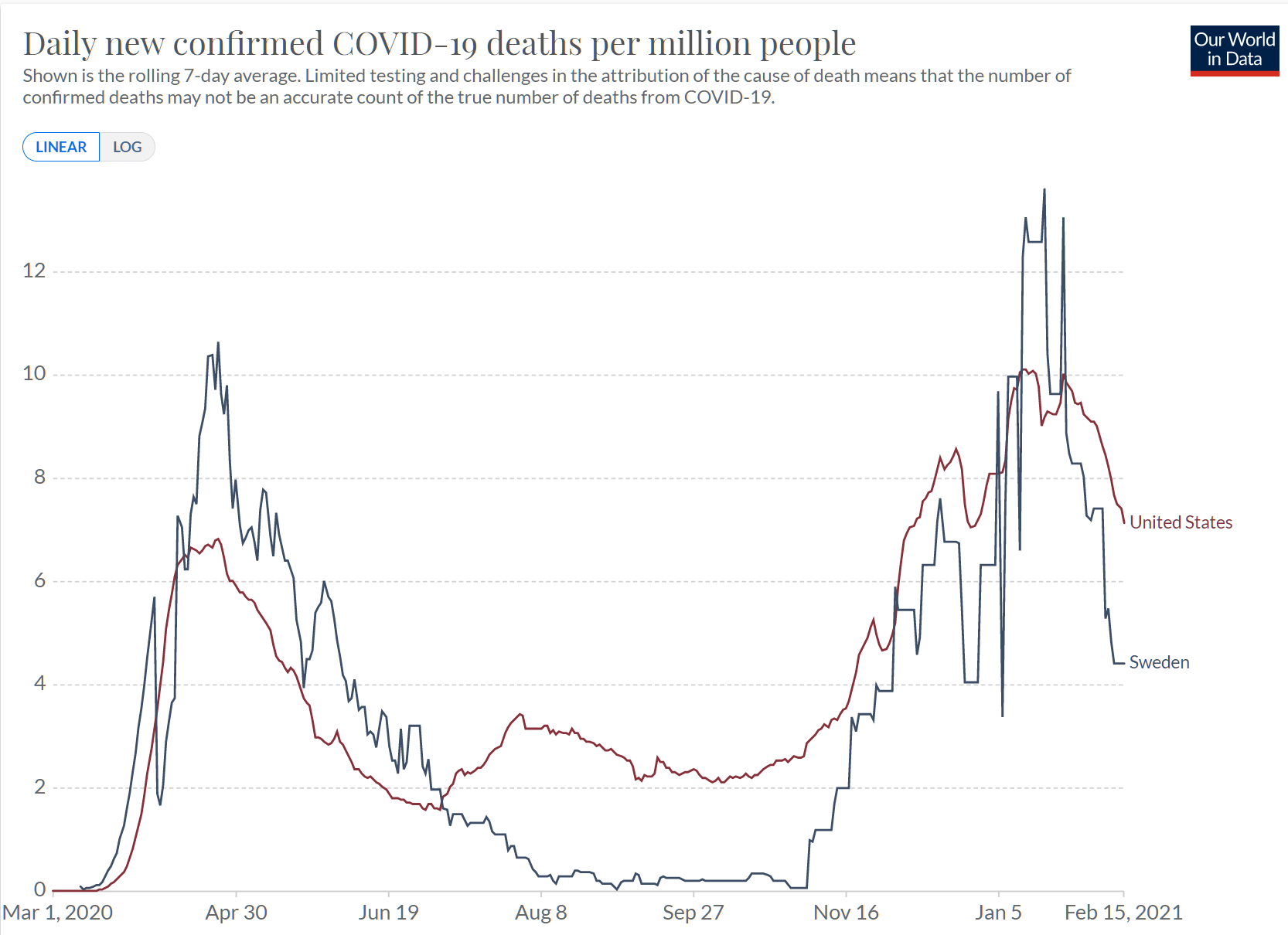
Let’s check that September prediction about Sweden

From September 28, Doom by December for the wicked unmasked Swedes:

By the end of December, 200 Swedes will be dying every day from coronaplague, unless they see the light and convert to the Church of Shutdown and don the hijab.

Associated terrifying chart from the “scientists”:

How did #Science do? WHO says that Sweden has experienced 18 deaths in the last 7 days, an average rate of 2.5 deaths per day or 1.25% of the forecast. Admittedly, this is not a perfect experiment. For the first time since March, the Swedes tweaked their policies slightly in November, e.g., adopting masks on crowded public transport, reducing the number of people who can attend a commercial (“public”) gathering from 50 to 8 (still possible to host a big party at one’s house and unmasked Swedes still gather regularly for school and work). The elderly King of Sweden, a guy with 11 palaces and 3 taxpayer-funded Gulfstream jets to fly among them, suggested that shutdown would have been a better policy than “give the finger to the virus” (young healthy Swedes who live in small apartments might have a different perspective on the costs and benefits of home confinement).

So… given a three-month time horizon, the expert scientific prediction regarding what would happen in Sweden was off by a factor of 80X.

Related:

  • Sweden’s total deaths in 2020 compared to previous years (The Swedish MD/PhDs said that half of the people who died with a COVID-19 tag would have died at some point in 2020 (due to old age and/or poor health); if they’re right, the upper limit on excess deaths should be half the COVID-19 death statistic. Keep in mind that you need to adjust for a larger population in figuring the death rate and that the “as of December 11” on the chart should really be “as of December 4” because it takes a while for death statistics to propagate. Sweden was home to 9.3 million people in 2010 and today has 10.4 million potential human hosts for the coronavirus.)
Full post, including comments

Assumption that masks are effective leads to conclusion that people of color are responsible for coronaplague

I was chatting with a California Mask and Shutdown Karen. Did the recent exponential plague in California, despite its mask rituals and nearly yearlong lockdown, change his views on the efficacy of masks and shutdown for containing COVID-19? From the NYT:

It turns out that the exponential plague just underlines the importance of masks. He blamed “Latinos” for causing the California plague. On the way to his house in the hills (he paid an extra $1+ million for a house 1/2 mile from the city limit so that his children wouldn’t have to go to school with the Black and brown Americans whose interests he says that he champions), he has seen “Latinos” barbecuing outdoors without masks on.

(Readers will not be surprised to learn that I educated him regarding the use of the term Latinx.)

So we’ve made a lot of progress in convincing rich white people that humans are in charge of coronavirus. Thus, when coronavirus “spikes” it must be due to something for which humans are to blame. But it seems that rich white people are not quick to blame rich white people. For rich white Californians, the Latinx are apparently the scapegoats (and also, via delivery services, the enablers of their ever-deeper bunkering).

(This is a little like Christianity versus Greek/Roman religion. If your Roman village is destroyed you can say “well, the gods are powerful sociopaths so we should sweep up and rebuild.” If your Christian village is destroyed, you must say “God is omnipotent, benevolent, and just and therefore we did something to bring this destruction down on ourselves.” The twist with the American coronaplague is that we aren’t a unified nation so it is always easy to find another group (Trump voters, Blacks, Latinx) to blame.)

Related:

Full post, including comments

California current COVID-19 rate more than double South Dakota’s

From the CDC: California (nation’s second most restricted state) now has the highest rate of current COVID-19 cases in the U.S., more than double the rate of never-masked, never-shut South Dakota (nation’s most free state) and about 5X the rate in give-the-finger-to-the-virus Sweden.

(South Dakota is at 43.)

From WHO:

(Adjust for 7 days to get the daily rate that the CDC uses and then for the fact that Sweden has 10.4 million population.)

And a comparison whose source I can’t find…

Full post, including comments

Are we going to waste three quarters of our vaccine supply?

“A Better Way to End the Pandemic Quickly” (MedPage Today):

The current plan is to give two doses, 21 days apart for the Pfizer product and 30 days apart for Moderna’s. Alternatively, all available doses could be given immediately, doubling the number of people who could be reached. Both Pfizer and Moderna report that the efficacy of a single dose is only about 50%. But a closer look at their incidence curves suggests that immunity appears to be maximized about 14 days after the first dose. In the Moderna trial, for example, most of the cases in the vaccine arm occurred during the first 2 weeks following the initial dose. We recognize that the vaccine was developed and tested on the assumption that two doses are necessary. Yet, the trial data suggest that a single dose provides substantial immunity. During this severe pandemic, it seems reasonable to use the available supply to reach as many people as possible in the short term. Delaying the second dose would maximize limited resources and could reduce serious illness and death. A recent projection suggests the U.S. will receive 40 million doses of the two mRNA vaccines by early 2021. A rough calculation suggests that vaccinating 40 million persons with these 40 million doses versus 20 million persons with two doses each could prevent over 100,000 severe cases and save over 10,000 lives.

Despite that fact that the Moderna vaccine was developed nearly a year ago (see “We Had the Vaccine the Whole Time”), testing has been so slow that we can suspect, but don’t know for sure, that one dose is sufficient!

If the MedPage Today authors (Michael H. Criqui, MD, MPH, and Robert M. Kaplan, PhD; maybe they are colleagues of Dr. Jill Biden, MD?) are correct, we are going to be wasting half of our vaccine supply by giving two doses when one is sufficient.

How might we waste half of the remaining half? By giving the vaccine to people who are already immune as a result of previous infection (nearly one third of the U.S. population had been infected as of November (NPR/CDC), which means it will be closer to 165 million by the time the vaccine is available to the average person).

[In the Department of Prescience: “Up to 150 million Americans are expected to contract the coronavirus, congressional doctor says” (March 11, 2020).]

Full post, including comments

The science of herd immunity evolves

From the World Health Organization, right now:

‘Herd immunity’, also known as ‘population immunity’, is a concept used for vaccination, in which a population can be protected from a certain virus if a threshold of vaccination is reached.

Herd immunity is achieved by protecting people from a virus, not by exposing them to it.

Same URL, but the archive.org version captured in November:

Herd immunity is the indirect protection from an infectious disease that happens when a population is immune either through vaccination or immunity developed through previous infection. This means that even people who haven’t been infected, or in whom an infection hasn’t triggered an immune response, they are protected because people around them who are immune can act as buffers between them and an infected person. The threshold for establishing herd immunity for COVID-19 is not yet clear.

It is tough to think of a time when science has progressed so quickly!

Also, in the Department of Evolution of Science, the W.H.O.’s January-June 2020 recommendation against masks for the general public:

Related:

Full post, including comments

If COVID-19 vaccines weren’t tested on likely COVID-19 victims, how do we know that they will reduce COVID-19 deaths?

Sweden, in which coronaplague was allowed to rage while the population continued sending children to school, sending adults to work, restaurants, the gym, etc., will have about the same death rate in 2020 as compared to 2010 (stats; be sure to adjust for population growth of 9.5 percent from 9.34 million in 2010 to 10.23 million today). This suggests that most of the people whose deaths were tagged to COVID-19 were, as the Swedish MD/PhDs said, on track to die from some other cause at some point in 2020. In other words, COVID-19 kills humans who are already 98-99 percent dead (watch out, Joe Biden, even if you do have a Dr. in the house).

What we’ve heard so far from the vaccine trials are the following:

  • the vaccines don’t stop people from getting infected or spreading the infection to others
  • the vaccines cut down on symptoms and severity of an infection

So… the vaccines might actually make an epidemic worse, in terms of the percentage of the population infected, because people who are infected won’t feel sick and therefore won’t #StayHomeSaveLives.

Maybe this would be fine if we can be sure that vaccinated people won’t die with a COVID-19 toe tag. But do the clinical trials tell us that? Did they go to nursing homes and find the sickest oldest most machine-dependent humans? Given that nursing homes are completely locked down, even if they had found such trial subjects, what could be learned from folks who, by design, are shielded from all exposure?

Let’s have a look at the Moderna FDA paperwork. Only 3 people in the vaccine group, out of 15,208 total, died during the study (approximately 3 months; see pages 17 and 18), which tells you that Moderna picked a much healthier population with a much longer life expectancy than the kinds of people who have been tagged on death with COVID-19 positive test result. (If we assume that a typical COVID-19-tagged death is among those with a life expectancy of 4 years, we would have expected at least hundreds of deaths during a similar study of vaccination among people who really need the vaccination. Note that the Swedish data suggest that 4 years is an overestimate.)

Table 6 says that 4 percent of the study participants had “two or more high risk conditions” and that 25 percent were over 65 years of age, but here in Maskachusetts before the state pulled the age-related data, the median age of a “COVID-19 death” was 82 and more than 98 percent of those had an “underlying condition.”

It is nice that a healthy out-and-about 66-year-old develops a good immune response from these injections, but does that tell us that an extremely unhealthy 82-year-old with just a year or two of life expectancy will develop a similarly good immune response?

So… is it fair to say that we can hope, but not expect, these vaccines to stop the kinds of “COVID-19 deaths” that have been Americans’ consuming obsession?

(A med school professor friend: “Good question, probably not.”)

Loosely related…

Full post, including comments

Our apolitical science-driven physicians

From the New England Journal of Medicine, i.e., the folks whom we can trust to give us science-informed advice on masks and vaccines, untainted by a political point of view… “Failed Assignments — Rethinking Sex Designations on Birth Certificates” (December 17, 2020):

We believe that it is now time to update the practice of designating sex on birth certificates, given the particularly harmful effects of such designations on intersex and transgender people.

Recognizing that the birth certificate has been an evolving document, with revisions reflecting social change, public interest, and privacy requirements, we believe it is time for another update: sex designations should move below the line of demarcation.

Designating sex as male or female on birth certificates suggests that sex is simple and binary when, biologically, it is not. Sex is a function of multiple biologic processes with many resultant combinations. About 1 in 5000 people have intersex variations.

Assigning sex at birth also doesn’t capture the diversity of people’s experiences. About 6 in 1000 people identify as transgender, meaning that their gender identity doesn’t match the sex they were assigned at birth. Others are nonbinary, meaning they don’t exclusively identify as a man or a woman, or gender nonconforming, meaning their behavior or appearance doesn’t align with social expectations for their assigned sex.

Moving sex designations below the line of demarcation wouldn’t imperil programs that support women or gender minorities, it would simply require that programs define sex in ways that are tailored to their goals.

Moving sex designations below the line of demarcation may not solve many of the problems that transgender and intersex people face. Controversies regarding bathrooms, locker rooms, and sports participation will continue, regardless of legal sex designations.

Today, the medical community has a duty to ensure that policymakers don’t misinterpret the science regarding sex and that medical evaluations aren’t being misused in legal contexts.

Also, “A Test of Diversity — What USMLE Pass/Fail Scoring Means for Medicine” (June 18, 2020):

The stakes are high for all students taking this first Step examination of the three required for medical licensure. But students from racial and ethnic groups that are underrepresented in medicine experience great angst.

Recently, the Federation of State Medical Boards (FSMB) and the National Board of Medical Examiners (NBME) decided to change score reporting from a three-digit numerical score for the Step 1 exam (the mean score for first-time takers was 230 in 2018) to a pass-or-fail outcome. … Although the effect on trainees from underrepresented groups remains uncertain, we believe that the change is a critical step toward diversifying the medical profession — particularly the most competitive, and simultaneously least diverse, medical specialties — opening a world of possibilities for physicians and patients alike.

The odds are stacked against students from underrepresented minority groups starting early in their scholastic journeys. Beginning in grade school, they may be subject to teachers’ racial and ethnic biases that can hinder their achievement. Socioeconomic factors such as neighborhood poverty and parental educational attainment may limit their access to high-quality schools, test-preparation resources, and supportive mentorship, widening the achievement chasm.

The medical examination system poses challenges that are especially burdensome to students of color and those with lower socioeconomic status. Step 1, much like the Medical College Admission Test (MCAT), places a financial burden on students that includes the cost of the exam ($645 in 2020) and the study materials required to prepare for it.

As with the MCAT, scores on Step 1 are lower among black, Hispanic, Asian-American, and female students than among their white male counterparts. Although this disparity has multiple causes, historically disadvantageous early education in minority communities probably plays an important role for members of underrepresented minority groups.

… we believe that holistic review will be a tide that raises all ships equitably.

The last sentence is my favorite. There are a limited number of slots for training the most lucrative and cushiest specialties, but everyone will have a better chance of obtaining a slot after this change.

Full post, including comments